RU58841, pyrilutamide, and clascoterone: which one is actually better?
All three try to sit in the androgen receptor so DHT cannot. Ranking them turns out to be much harder than the internet suggests, and the reason why is more interesting than the ranking.
Uses the best matching voice on your device. No subscription or per-listen fee.
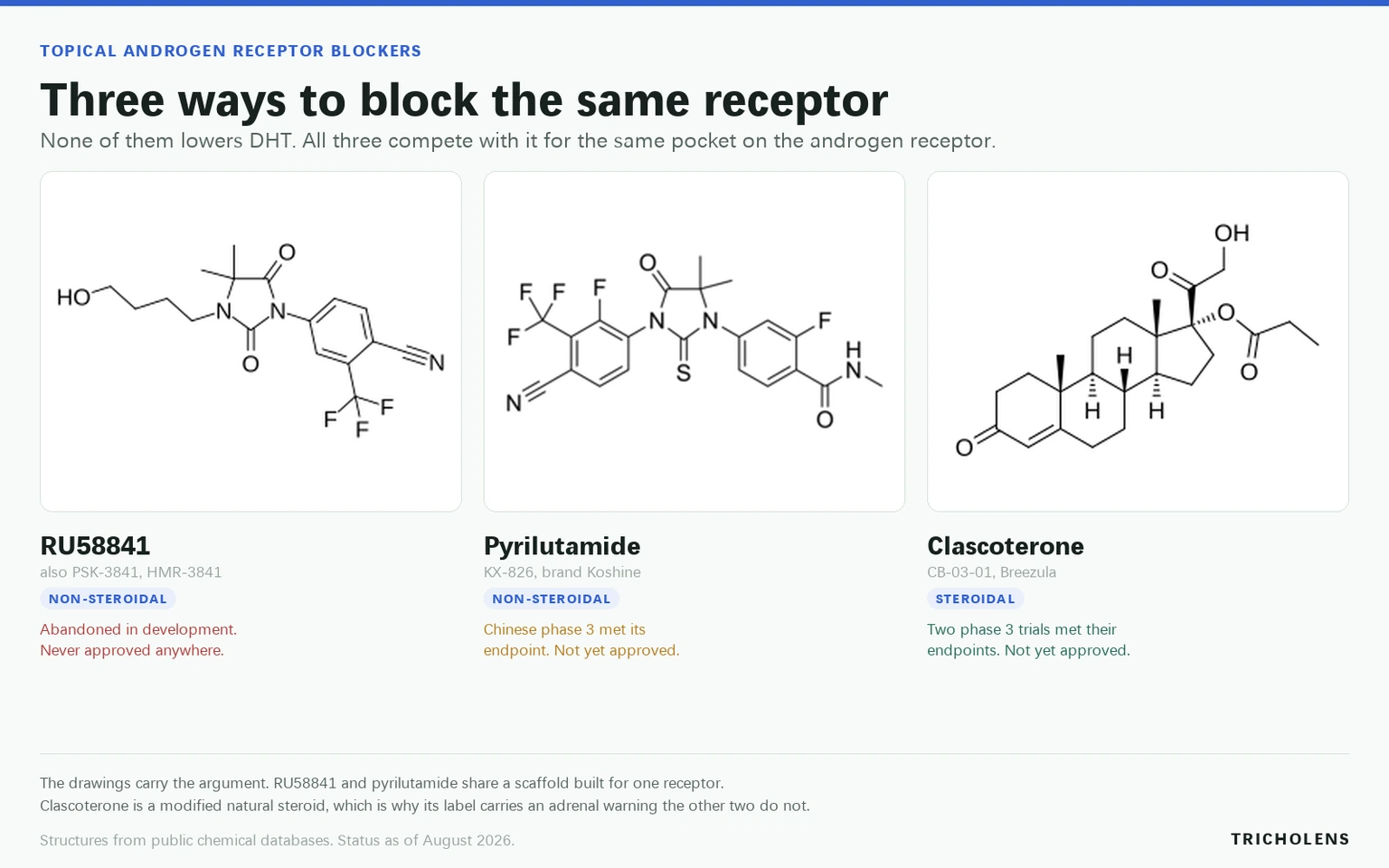 Open full size
 Key takeaways
- All three block the androgen receptor rather than lowering DHT, so all three depend on keeping enough drug at the follicle to outnumber the hormone they are competing with.
- The binding numbers used to rank them online do not support a ranking. RU58841’s comes from a chemical supplier’s catalog, pyrilutamide’s comes from a company patent, and clascoterone has no published number at all.
- Pyrilutamide has the most complete public numbers: 10.65 more hairs per square centimeter than vehicle at 24 weeks, in 666 men, at p below 0.0001.
- Clascoterone has the largest program, 1,465 men, but reported its phase 3 result only as a ratio, never as hairs per square centimeter.
- Pyrilutamide’s first phase 3 missed because the treated men never separated from vehicle, and COVID is why. Kintor’s medical lead describes being forced to pause the trial and being unable to ship drug to quarantined patients. Non-adherence produces exactly that failure, and the rerun confirms it: the same 0.5% strength later worked.
- RU58841 ran two registered human trials that finished in 2002 and 2003. Neither ever reported a result, and no human trial of it has ever been published.
- None of the three is approved for hair loss anywhere in the world.
Three drugs, one receptor, and a question that resists a clean answer
If you have spent any time reading about hair loss you will have met these three names. RU58841, the one people buy from research-chemical websites. Pyrilutamide, usually written KX-826, the one from a Chinese company that just reported a successful late-stage trial. And clascoterone, also called CB-03-01 or Breezula, the one already approved as an acne cream and now finishing a large trial for hair.
They are trying to do the same thing. None of them reduces how much dihydrotestosterone, DHT, your body makes. All three go after the androgen receptor instead, the protein DHT has to sit inside before it can tell a hair follicle to shrink. Occupy that pocket with something else and the hormone arrives to find the seat taken.
So which one works best? The honest answer is that the question cannot be settled with the evidence that exists, and the reasons why turn out to be more useful than any ranking would have been. There has never been a study of any kind comparing any two of these three molecules. A search of the medical literature for any paper mentioning clascoterone alongside either RU58841 or pyrilutamide returns nothing at all.1
What can be done is to look at what each one has actually demonstrated, in public, in a form somebody outside the company can check. That produces a much clearer picture than the binding-affinity arguments people usually have, and it separates the three quite decisively.
| RU58841 | Pyrilutamide (KX-826) | Clascoterone (CB-03-01) | |
|---|---|---|---|
| Chemical family | Non-steroidal | Non-steroidal | Steroidal |
| Best human evidence | Two registered trials, no results ever reported | Phase 3 in 666 men, company topline only | Phase 3 in 1,465 men, company topline only |
| Published in a journal? | Never | Never | Never, for hair loss |
| Approved for hair loss | No, and abandoned in 2007 | No. China filing planned for 2026 | No. US filing targeted for Q1 2027 |
| Approved for anything else | No, nowhere, ever | No, but sold as a cosmetic | Yes. Winlevi 1% acne cream, US and EU |
| How you can get it today | Unregulated research chemical | Sold worldwide as a cosmetic, shipped to 150+ countries | Soon, but not yet. Trials are done, US filing due Q1 2027 |
Two of them are near relatives. The third is not related at all
Before any of the evidence, it is worth seeing what these three actually are, because the shapes explain a lot of what follows. The panel below builds each molecule and rebuilds it into either of the others. Mapped scaffold atoms stay anchored while unmatched groups are taken apart and replaced, so the movement shows how much of the molecular framework changes.264518
Turn RU58841 into pyrilutamide and much of the scaffold stays in place. Twenty of pyrilutamide’s 33 non-hydrogen atoms map onto the RU58841 structure. The 2-carbonyl becomes a thioxo group, the hydroxybutyl substituent is replaced by a fluoro-N-methylbenzamide ring, and another fluorine is added to the cyano-bearing ring. They are close chemical relatives, but they are not the same molecule.
Now turn either of them into clascoterone and the mapped non-steroidal scaffold clears completely. Clascoterone instead uses four carbon rings fused into the rigid steroid frame your body already uses to build testosterone and cortisol. That is not a stylistic difference. It is why the first two can be built to fit the androgen receptor and very little else, while clascoterone starts from a shape that half a dozen other hormone receptors also recognize, and has to buy its selectivity a different way.4547
IUPAC name4-[3-(4-Hydroxybutyl)-4,4-dimethyl-2,5-dioxo-1-imidazolidinyl]-2-(trifluoromethyl)benzonitrile
Pick another name above to rebuild this molecule into it. Mapped scaffold atoms stay anchored while unmatched groups are taken apart and replaced.
Blocking a receptor is a numbers game, not a duel
Almost every online argument about these drugs is really an argument about binding affinity, and almost all of it rests on a misunderstanding of what binding affinity is.
Here is the picture people carry around: one drug molecule and one DHT molecule approach a receptor, the one that binds more tightly wins, and that is that. It is a duel. It is also wrong.
What actually happens is constant, restless traffic. Molecules drift into the receptor pocket and fall out of it again, millions of times, and at any given instant some fraction of your receptors are occupied and the rest are empty. Binding affinity does not decide a contest. It sets the odds on each encounter. The formal version of this is the law of mass action, and the number people quote, the dissociation constant or Kd, has a precise meaning under it: Kd is the concentration at which exactly half the receptors are occupied at any instant. Getting occupancy up near total requires a concentration many times higher than the Kd.2
Two consequences follow, and they matter more than any affinity number.
The first is that concentration is at least as important as affinity. A drug that binds somewhat less tightly than DHT can still occupy most of the receptors if there is far more of it around. A drug that binds more tightly will lose anyway if it never reaches the follicle in quantity. This is why all three of these are topicals applied directly to the scalp, and why the serious ones are dosed twice a day.
The second is that how long a molecule stays put may matter more than how tightly it grabs. Affinity is really a ratio of two speeds, how fast a molecule binds and how fast it lets go. A well-known argument in pharmacology holds that the length of time the drug stays attached, its residence time, often predicts the real-world effect better than equilibrium affinity does. There is a related effect in tissue, where a molecule that falls off a receptor frequently rebinds to that receptor or a neighbouring one before it can drift away, so occupancy in a real scalp outlasts what the raw numbers suggest.34
This is also what these drugs are up against. DHT binds the androgen receptor around twice as tightly as testosterone does, and it lets go three to five times more slowly, which is what makes it the more powerful signal even though there is much less of it around. And balding scalp is a harder target than it looks: dermal papilla cells taken from balding scalp carry measurably more androgen receptor than cells from unaffected scalp, so there is more to occupy exactly where you need to occupy it.567
The binding figures everyone quotes will not hold a ranking
You will see a comparison like this in every thread on the subject. RU58841 binds at about 1.8 nanomolar. KX-826 comes in at 0.28 nanomolar, so it must be the stronger one. Clascoterone is somewhere behind both.
Every part of that is unsafe, and it is worth walking through why, because the same trick appears constantly in supplement and research-chemical marketing.
Start with RU58841. The figure quoted is a set of dissociation constants, 1.8 nanomolar for the human receptor and 1.1 for the rat, and it is always attributed to a 1994 paper by Battmann and colleagues. That paper exists. Its abstract does not contain the numbers. It contains no quantitative affinity data at all, only the sentence that the compound displays high affinity for the hamster prostate and flank organ androgen receptors. The full five-value panel that circulates online, covering human, rat, mouse and two hamster tissues, is retrievable from the datasheets of chemical suppliers, which cite the paper but publish figures the paper’s abstract does not carry. Different vendors also disagree with one another, and at least one reports an association constant where another reports a dissociation constant, which are different quantities.8910
Now pyrilutamide. Its 0.28 nanomolar figure is not a dissociation constant at all, it is a half-maximal inhibitory concentration, an IC50, and it traces to a patent filed by the company that makes the drug. No assay format, no tracer, no concentrations, nothing that would let anyone reproduce or interpret it has ever been published.11
And clascoterone has no publicly retrievable affinity number whatsoever. Not in its FDA label, not in its mechanism papers, not in the review literature. Its original characterization quantified potency only as a ranking in a hamster test: roughly three times more potent than flutamide, about twice as effective as finasteride, about as active as cyproterone acetate.121347
So the famous three-way comparison is a vendor catalog, a company patent, and a blank space.
Even if all three numbers were solid, they still could not be lined up, because a Kd and an IC50 are not the same measurement. A dissociation constant describes how tightly a molecule sits in a receptor at equilibrium. An IC50 describes the concentration needed to knock down half of some measured response, and it depends heavily on how the experiment was set up. The 1973 paper everyone cites for converting between them, by Cheng and Prusoff, actually concludes that the two are not equal when the inhibition is competitive, which is exactly the case here. Converting requires knowing the concentration of the tracer molecule used in the assay and that tracer’s own binding constant, neither of which is published for any of these three.141516
How much can the setup alone change the answer? There is a clean illustration in the androgen receptor literature. When researchers measured how fast testosterone and DHT let go of an isolated fragment of the receptor, the two looked nearly identical, 25 minutes against 32. When they measured the same two hormones against the full-length receptor, the gap opened to 55 minutes against 188. Same molecules, same question, and the answer moved by a factor of four depending on what they were tested against.5
RU58841: a real drug program that stopped, and never said why
RU58841 is genuinely old. The RU prefix comes from Roussel Uclaf, the French pharmaceutical company where it originated. As the program changed hands the molecule was renamed twice, first to HMR-3841 and then to PSK-3841. All three codes refer to the same compound, which matters because the human trials were registered under a name almost nobody searches for.1718
The animal evidence is real and reasonably good. In stumptailed macaques, a species that goes bald in a pattern resembling ours, topical RU58841 produced what the researchers described as a potent increase in the density, thickness and length of hair. In a separate study, human scalp grafts taken from balding men were kept alive on mice and treated for six months. Among the grafts treated with RU58841, 8 of 29 active follicles started a new growth cycle, against 2 of 28 in the control grafts, and hair grew measurably faster.1920
It then went into humans, and this is the part that gets misdescribed. Two trials were registered, both retrospectively and both on the same day in October 2005, years after they had actually finished.2122
The first ran in France for four weeks in 2002, targeting 60 men. Its purpose was not to grow hair. Its primary outcome was safety, measured through hormone profiles on days 1, 15 and 28, and one of its secondary questions was whether the men’s female partners were being exposed to the drug in ordinary daily life, which is why the study enrolled the partners too. Hair count was not an outcome of that trial at all.21
The second is the one that matters. It ran in the United Kingdom and Belgium from October 2002 to August 2003, targeting 120 men, comparing 2.5% and 5% solutions applied once daily against vehicle over six months, with total and anagen hair counts as a primary outcome. That is a properly designed efficacy trial.22
It has never reported a result. In both registry records the fields for results, publications and adverse events are empty, and have stayed empty through updates as late as 2014. Neither trial ever appeared on ClinicalTrials.gov. No human trial of RU58841 has ever been published in a medical journal under any of its three names. A search of the entire indexed medical literature returns 17 records for the molecule, and not one of them is a clinical trial.222324
What people quote instead is a marketing page. The archived ProStrakan website said the molecule had completed a proof-of-concept phase 2 study in alopecia and had demonstrated similar efficacy after six months of treatment as that observed with current oral therapy for alopecia after twelve months, based on the increase in net hair count, with no systemic antiandrogenic effect observed, in 90 patients.25
Read that carefully, because it is thinner than it looks. The page never names finasteride, it says current oral therapy. It gives no hair count, no comparison group result, no statistics, and no adverse event data. Its figure of 90 patients matches neither registered trial, whose targets were 60 and 120. And the sentence directly after the efficacy claim is the giveaway: this product is available for licensing. It is a sales page, written to attract a buyer.25
No buyer came. The drug databases record the ending without explaining it: two entries in May 2007 reading, simply, no development reported. ProStrakan was later bought by Kyowa Hakko Kirin and no successor has ever revived the program. No company statement, filing or report explaining the decision could be located.17
Pyrilutamide: a failure, a higher dose, and a success
Pyrilutamide, KX-826, comes from Kintor Pharmaceutical of Suzhou, China, the same company behind the androgen receptor degrader GT20029. It has by far the most complete public trial record of the three, and it is the only one of them whose late-stage numbers have been disclosed in full.26
One naming point first, because it causes real confusion. Koshine, styled KOSHINÉ, is not the drug’s brand name. It is Kintor’s cosmetics brand, and KOSHINE 826 is the trade name used when the compound is sold to other companies as a cosmetic ingredient. The investigational drug has no brand name, for the straightforward reason that it is not approved anywhere.27
The program began with two American phase 1 studies in Miami, one single-dose and one running fourteen days, both about safety and how much drug enters the blood. A Chinese phase 2 in 120 men followed, and the company reported that the 0.5% twice-daily arm gained 15.34 more hairs per square centimeter than placebo at 24 weeks, at p equal to 0.024. That dose was carried into phase 3. A separate phase 2 in 160 Chinese women reported 11.39 hairs over placebo at p equal to 0.0087.2829303132
An American phase 2 in 123 men also ran, finishing in February 2023. Its registered primary endpoint was explicitly a comparison against placebo. Kintor headlined the result Successful Completion, and the only figure it gave was that the 0.5% twice-daily group increased by about 10 hairs per square centimeter compared with baseline, statistically significant at p equal to 0.0088. On the placebo comparison, the one the trial was designed around, it said only that the drug indicated an improvement. No placebo-adjusted difference and no placebo-adjusted p-value has been released in the three and a half years since, and no results have been posted to the registry.3334
Then the first phase 3 failed. It was a large trial, 740 Chinese men, 0.5% twice daily against vehicle for 24 weeks. In November 2023 Kintor reported that hair counts rose against baseline with high significance, at p below 0.0001, and that the drug beat placebo at every visit but that none of those differences reached statistical significance. Read that carefully, because the shape of the failure matters later. The treated men grew hair. What they did not do was separate from the men on vehicle.3536
What happened next is the most informative thing in the whole program. Kintor went back and doubled the concentration. The rerun was an adaptive trial testing both 0.5% and a new 1.0% strength, and the company’s stated reason for the higher strength was that it significantly increased how much drug stayed on scalp cells. A 90-man first stage reported in July 2025. The main stage, 666 men, reported on 18 March 2026.373839
Those results are the clearest numbers any of these three drugs has produced. Hair count rose 15.33 per square centimeter on 1.0% twice daily, 14.46 on 0.5%, and 4.68 on vehicle. That gives vehicle-adjusted gains of 10.65 and 9.78 hairs per square centimeter, both at p below 0.0001. Kintor reported excellent safety with no drug-related serious adverse events, though it disclosed no adverse event rates, no secondary endpoint results and no confidence intervals.40
Two things about that deserve flagging. The 0.5% arm, the exact strength that had failed in 740 men, worked this time, which points away from dose as the reason for the first failure and toward how that first trial was run. The next section takes that up, because there is a specific claim about it. And the vehicle arm behaved very differently between the two stages of the same adaptive trial, gaining 8.73 hairs in the 90-man stage against 4.68 in the 666-man stage. Control arms are not stable things.3840
A separate 52-week open-label study reported good long-term tolerability with no drug-related sexual dysfunction, which is the reassurance people most want from an antiandrogen. It had no control arm, so its efficacy figures, that 46% of patients gained at least 10 hairs per square centimeter, should be read as description rather than proof.41
Kintor’s medical lead put numbers to that in a 2024 interview, and they are worth having because the company has never published an adverse event table. Across the 740-man phase 3 and the roughly 200-man long-term study, he counted two reported sexual adverse events in total. One was erectile dysfunction, in a man on placebo. The other was mild, self-reported, needed no treatment, and occurred in a man who was having a shingles outbreak at the same time.44
COVID broke that trial, and the failure has the fingerprints to match
The first phase 3 did not fail because men on pyrilutamide stopped growing hair. They grew hair, at p below 0.0001 against their own starting point. It failed because they could not be told apart from the men rubbing on vehicle. That is a specific kind of failure, and it has a specific and unglamorous explanation that happens to be true: for long stretches of that trial, the men in it were not putting the drug on their heads. China was locked down. Kintor has said so directly, on camera, and you can watch it below.3644
The reason this is treated as a rumor is that the statement is not written down anywhere obvious. Nothing in Kintor’s English or Chinese announcement archive, in its exchange filings or in the Chinese financial press attributes the failure to the pandemic. The company’s own announcement of 27 November 2023 gives the numbers and offers no explanation for them at all.4236
It was said out loud instead, in English, on the YouTube channel KwRx, run by the Reddit user noeyys, in an interview with two Kintor scientists published in December 2024. Wilson Lou, a physician trained at Beijing Medical School with a PhD from the University of Pennsylvania who runs the medical side of the program, was asked directly what had changed between the trial that failed and the ones that worked, and whether compliance was better the second time. The question and his answer start at 18:08.44
His answer was blunt, and it started with the timeline. A six-month study took two years to run from beginning to end, and recruitment was not the reason, because in his words a patient is not difficult to recruit at all. Then the cause: as you probably know, the COVID situation in China had a huge impact, and we were forced to stop the study.44
On compliance he was more specific than the secondhand version of this story usually is. Compliance is out of the window, he said, you really cannot check. Even for the people who needed the drug, the company could not ship it, because everybody was quarantined at home. He added that when people are worried about food, putting a solution on your hair is not a priority, and that the stress and the fever of the illness itself can change hair on their own.44
Then he gave the comparison that makes the claim checkable. The later trial he contrasted it with began at the end of December 2023, after China had dropped its quarantine policy, so nearly all of its recruiting happened in normal conditions. The product, he said, was the same. What differed was compliance and patient follow-up. He also noted that his was not the only Chinese company whose long trials came out of that period looking strange.44
Here is why that fits rather than merely sounding convenient. Non-adherence has a direction. A man randomized to the drug who never applies it is still counted in the drug group, so his result drags the treated average down toward the control average. Do that to enough men and the gap between the two groups closes, while both groups still look like they improved against their own starting point. It also scatters results more widely, which costs a trial the statistical power it was sized for. Non-adherence cannot manufacture an effect that is not there. It can only bury one. And a buried effect looks exactly like what that trial reported: real growth from baseline, ahead of vehicle at every single visit, and not once by enough to count.36
Two qualifications are worth keeping. This came thirteen months after the failure, from the company whose drug missed, spoken rather than filed. And the most contemporaneous account emphasizes something else: two weeks after the failure, Kintor founder and chief executive Tong Youzhi told a Chinese interviewer that a larger trial across more centers introduces variables that erode the signal seen in phase 2, that the result surprised everyone at the company, and that they would consider raising the dose.43
Those two accounts are not in conflict, and the data settled the question anyway. Kintor did raise the dose. But the 0.5% arm, the exact strength that had failed in 740 men, hit its endpoint in the rerun at 9.78 hairs per square centimeter over vehicle, at p below 0.0001. If the first failure had been a dose problem, that arm had no business succeeding. It succeeded, which leaves how the first trial was run as the explanation standing.40
So the accurate way to describe that trial is not that pyrilutamide failed in it. It is that the trial was run in conditions that left it unable to tell the difference, the company said so, and when the same strength was tested again under normal conditions the difference appeared. That is a fair reading, and it is also the one that had to survive a second dataset before anyone was entitled to it.
Clascoterone: the biggest program, reported in ratios
Clascoterone is the odd one out, and the first thing to understand is that it is a steroid. It is cortexolone 17-alpha-propionate, a modified version of a natural precursor in your own cortisol pathway. Look at the three structures side by side and it is obvious: RU58841 and pyrilutamide are built on the same kind of compact non-steroidal frame, while clascoterone has the four fused rings of a steroid hormone. It is routinely misfiled as non-steroidal online, including by people who should know better.45
That matters because the four-ring shape is what your other steroid receptors recognize too, so a steroidal antiandrogen carries a cross-reactivity risk a non-steroidal one does not. Clascoterone’s answer is not a different shape but a different strategy: it is designed to be broken down quickly once it leaves the skin, so the effect stays local.
It is the only one of the three that is an approved medicine, though not for hair. The FDA approved Winlevi, a 1% cream, for acne in August 2020. The hair-loss product is a different thing: five times the concentration, in an alcohol solution rather than a cream, developed under the name Breezula.4647
The local-only strategy works less completely than the marketing suggests, and the evidence for that is not from critics but from the company’s own peer-reviewed paper. A published phase 1 study states plainly that when used in a cream formulation little of the drug is absorbed, but that the solution formulation developed for androgenetic alopecia leads to a measurable systemic concentration and accumulation of the antiandrogen. The acne cream’s own FDA label carries a warning for suppression of the adrenal stress-hormone axis, seen in 5% of adults and 9% of adolescents at day 14, and records a potassium signal as well.4847
European regulators took this seriously enough to refuse the acne cream outright in April 2025, on the grounds that there is a risk of the medicine being absorbed into the blood and suppressing the hormonal axis, which could impair growth and sexual maturation in adolescents. Approval came only on re-examination in August 2025, with a restricted indication, dose limiting, monitoring, and adolescent use confined to facial acne. That is the regulatory history of the 1% cream. The hair product is five times stronger.49
The mid-stage hair data are the best-documented part of the story and they look good. A 404-man dose-ranging trial in Germany reported absolute six-month gains of 13.01, 12.21 and 20.79 hairs per square centimeter for the 2.5%, 5% and 7.5% twice-daily arms, against minus 0.11 for vehicle. At twelve months the placebo-adjusted differences were 10.2, 13.8, 14.3 and 12.7 hairs. Notably, phase 3 went ahead at 5%, not at the numerically best 7.5%.5051
Then the phase 3 program, and here the reporting changes character. SCALP1 and SCALP2 enrolled 1,465 men between them, the largest program any of these three drugs has run. In December 2025 Cosmo announced that both trials met their hair-count endpoint, and reported the result as a 5.39-fold relative improvement over vehicle in one study and 1.68-fold in the other.525354
No absolute hair counts were given. Not for the treated arms, not for the vehicle arms, not in that release, not in the April 2026 twelve-month release, not in the July 2026 half-year report, and not on either trial registry. Every publicly available efficacy figure for this program is a ratio.545556
That choice makes the result impossible to place. A ratio is a fraction, and its size is driven by its denominator, which here is however much the placebo group happened to change. The company’s own phase 2 shows exactly how unstable that denominator is: its vehicle arm moved by minus 0.11 hairs per square centimeter. Divide by a number that close to zero and the ratio can be made enormous while the actual gain stays ordinary. It also explains the otherwise baffling gap between the two phase 3 results, 5.39-fold against 1.68-fold in trials the company itself describes as identical in design. The likeliest explanation is not that the drug worked three times better in one of them but that the two vehicle arms behaved differently.50
The same release also asserts that clascoterone blocks DHT at the follicle without systemic absorption, which contradicts the company’s own published phase 1 paper quoted above. And its arithmetic is internally inconsistent: it equates 5.39-fold with 539%, but a 5.39-fold ratio is a 439% increase. The company uses both phrasings in one document.5448
For contrast, when the same company reported the acne trials that won FDA approval, it published absolute numbers: success rates of 18.8% and 20.8% against 8.9% and 6.5% on vehicle, and absolute lesion count reductions. It chose ratios only for hair.57
Open full size Two reporting tricks that show up in all three stories
You do not need a statistics background to catch the two moves that do most of the work in hair-loss marketing. Both appear in the material above.
The first is comparing a group against its own starting point instead of against the control group. It sounds reasonable and it is close to meaningless, because the control group improves too. Bland and Altman showed in 2011 that testing each randomized group separately against its own baseline is invalid and biased, and quantified how badly: the real false-positive rate of that procedure can reach 50% for two groups and 75% for three, against the 5% everyone assumes. Their worked example is a skin-cream trial where the active group had a significant within-group change, the vehicle group did not, and the actual difference between the two groups was not significant at all.58
Kintor’s November 2023 announcement of its failed phase 3 contains both framings in adjacent sentences, which makes it an unusually clean specimen. The drug promoted hair growth compared to baseline with statistical significance at p below 0.0001. Compared with placebo, there was improvement at all visit points, with no statistical significance. The first sentence is the impressive one and the second is the trial result.36
The second move is reporting a relative change instead of an absolute one. A 5.39-fold improvement sounds like a different category of result from 10 extra hairs per square centimeter, even when the two describe the same finding. The relative version also hides its own denominator, so you cannot tell whether the drug did well or the placebo group simply did badly.
There is a third thing worth knowing, which is not a trick but a genuine feature of this field: control arms are wildly inconsistent. Documented changes in vehicle groups over comparable periods include minus 10 hairs per square centimeter, plus 3.9, plus 4.68, plus 6.7, plus 8.73, and minus 0.11. Part of that is regression to the mean, the statistical tendency of people selected for having a problem to look better on remeasurement. Part is physical: at least one trial suggested that massaging a vehicle into the scalp twice a day increases local circulation, and that starting a study in autumn and finishing in spring flatters both arms.645960
That variability is why a drug’s effect must always be read as the gap between the arms, and why a ratio built on top of an unstable denominator tells you very little.
Is 10.65 hairs good?
The only pivotal number available in absolute terms belongs to pyrilutamide, so it is the only one that can be placed against the drugs people already take. It compares respectably.
Finasteride 1 mg, the most studied drug in this field, produced 107 more hairs than placebo at twelve months in its pivotal trials, in a one-inch circle covering 5.1 square centimeters, which works out to roughly 21 hairs per square centimeter. A separate 48-week study using an actual one-square-centimeter window found a 17-hair difference. Topical 5% minoxidil produced about 14.7 hairs over vehicle at 48 weeks. The closest methodological match to pyrilutamide’s trial is the phase 3 of topical finasteride spray, which used the same 24-week window and the same tattooed one-centimeter target area, and produced vehicle-adjusted differences of about 13.5 for the topical and 14.4 for oral finasteride.61626364
So pyrilutamide’s 10.65 hairs at 24 weeks sits slightly below topical finasteride measured the same way over the same period. That is a real result, in a believable range, and not a revolution.
Now the caveats, and there are enough of them that this should not be read as a league table.
- The counted area is not standardThe finasteride pivotal trials counted hairs in a 5.1 square centimeter circle. Modern trials use one square centimeter. Even within one company the definition moves: Kintor’s GT20029 trial counted in 0.903 square centimeters while its KX-826 trial used a full one.
- The threshold for a countable hair is not standard eitherSome trials count hairs at least 40 micrometers thick, others at least 30. Lowering the bar moves hairs from uncounted to counted without anything growing.
- The counting software has known errorA published critique found automated digital analysis underestimated mid-scalp density by roughly 27%, and argued the claim that it is suitable for treatment-response trials is overstated.
- The populations differBaseline scalp density runs around 226 hairs per square centimeter at the vertex in people of European descent and about 171 in healthy young Chinese men. The pyrilutamide trials were Chinese; the finasteride and clascoterone trials were not.
- The durations differTwenty-four weeks against forty-eight weeks against twelve months. Hair counts keep moving, and the drug’s own gain and its gap from placebo move in different directions over years.
- The comparison has never been runEvery sentence above compares separate trials done by different people at different times. The one study that ever put a topical antiandrogen head to head against minoxidil, a 95-man clascoterone trial that finished in May 2016, has never reported a result.
So which one is better?
By strength of public evidence, the order is clear, and it is not the order the binding numbers would give you.
- 01Pyrilutamide is first, narrowly, and on transparency rather than potency
It is the only one of the three that has stated a late-stage result the way results should be stated: 666 men, 15.33 hairs against 4.68 on vehicle, a gap of 10.65, p below 0.0001. It also has the most complete registered trial history, a 52-week safety study, and a failure it disclosed rather than buried. Its weakness is that all of this is still company reporting, none of it is published, and its US registry entries sit unposted years after completion.
- 02Clascoterone is a very close second, and could easily be first
It has the largest program, 1,465 men, the only regulatory approval of the three for anything, and by far the deepest peer-reviewed pharmacology. Its phase 2 numbers, which were reported in absolute terms, are strong. It sits second here only because its phase 3 was reported as a ratio, which makes the size of the win unknowable from outside. Publish the absolute hair counts and this ranking may well invert.
- 03RU58841 is a distant third, on evidence rather than on chemistry
The molecule may well work. The animal data are decent and it reached a properly designed six-month efficacy trial. But that trial reported nothing, no human trial of it has ever been published, development stopped without explanation nearly twenty years ago, and what is sold today has no manufacturing standard behind it. Third place here reflects an absence of evidence, not evidence of absence.
What would change this ranking
This is a snapshot of a moving situation, and the specific things that would move it are worth naming so you can watch for them rather than for noise.
- Cosmo publishes absolute hair countsIf clascoterone’s phase 3 gap turns out to be comfortably above 10.65 hairs per square centimeter, it takes first place outright. If it is below, the ratio reporting starts to look like a choice rather than a convention.
- Either phase 3 appears in a peer-reviewed journalConfidence intervals, adverse event tables, dropout handling and prespecified analyses are all invisible right now for both drugs.
- A regulator actually approves oneKintor targets a Chinese filing in the second half of 2026 with approval hoped for 2027. Cosmo targets a US filing in the first quarter of 2027 and Europe in the second. Neither has filed anything yet.
- The unpublished trials reportThe 2016 clascoterone study against minoxidil, the 2003 RU58841 efficacy trial, and the American pyrilutamide phase 2 all have results somewhere. Any of them would change the picture.
- Someone runs a head-to-headNo study has ever compared any two of these three, in humans or in a test tube. Until one does, every comparison here included is arithmetic across separate experiments.
- Long-term safety data accumulatesA 2026 analysis of the FDA’s adverse event database found 1,085 reports involving clascoterone and flagged adrenal axis suppression among the signals, alongside a reproductive and breast disorder signal. That is the acne cream at 1%. The hair product is five times stronger and taken indefinitely.
The useful conclusion is not the ranking
If you want the one-line answer: pyrilutamide and clascoterone are both real, both have late-stage evidence that they beat placebo, and both are close enough that the ordering depends on a number one of them has not released. RU58841 is not in the same conversation, not because the molecule is bad but because twenty-three years after its last trial finished, nobody has ever said what happened in it.
The more durable takeaway is about how to read the next one of these, and there will be a next one.
Ignore binding constants unless the assay is described. Ask for the gap between the treated group and the placebo group, in hairs per square centimeter, over a stated number of weeks. Treat a change from baseline as no evidence at all. Treat a ratio as a number with something missing underneath it. Notice whether a company that publishes absolute results for one product switches to relative ones for another. And when a company explains away a failure, do not accept or reject the explanation on the spot, wait for the next dataset to agree or disagree with it, because that part is not in the company’s gift.
Apply those checks and most of the noise around hair-loss drugs resolves. Two of these three pass them. One never got the chance.
Sources & further reading
We prioritize official labels, professional medical organizations, and peer-reviewed literature. Sources accessed for this guide on .
- 1PubMed search: clascoterone or cortexolone 17 combined with RU58841, pyrilutamide or KX-826, zero results
PubMed, National Library of Medicine
- 2Law of mass action and fractional receptor occupancy
GraphPad Prism Curve Fitting Guide
- 3Drug-target residence time and its implications for lead optimization
Nature Reviews Drug Discovery, 2006;5:730-739
- 4Effects of target binding kinetics on in vivo drug efficacy: koff, kon and rebinding
British Journal of Pharmacology, 2016;173(15):2319-2334
- 5Modulation of androgen receptor activation function 2 by testosterone and dihydrotestosterone
Journal of Biological Chemistry, 2007;282(35):25801-25816
- 6Testosterone at high concentrations interacts with the human androgen receptor similarly to dihydrotestosterone
Endocrinology, 1990;126(2):1165-1172
- 7Balding hair follicle dermal papilla cells contain higher levels of androgen receptors than those from non-balding scalp
Journal of Endocrinology, 1998;156(1):59-65
- 8RU 58841, a new specific topical antiandrogen: a candidate of choice for the treatment of acne, androgenetic alopecia and hirsutism
Journal of Steroid Biochemistry and Molecular Biology, 1994;48(1):55-60
- 9RU-58841 product datasheet, catalog item 24680
Cayman Chemical via Bertin Bioreagent
- 10RU58841 product page reporting a conflicting association constant
Cellagen Technology
- 11Substituted thioimidazolidinone androgen receptor antagonists and uses thereof, patent CA2829322
Google Patents, assigned to Suzhou Kintor Pharmaceuticals
- 12Cortexolone 17-alpha-propionate (clascoterone) is an androgen receptor antagonist in dermal papilla cells in vitro
Journal of Drugs in Dermatology, 2019;18(2):197-201
- 13Biological profile of cortexolone 17-alpha-propionate (CB-03-01), a new topical and peripherally selective androgen antagonist
Arzneimittelforschung, 2004;54(12):881-886
- 14Relationship between the inhibition constant and the concentration of inhibitor which causes 50 per cent inhibition of an enzymatic reaction
Biochemical Pharmacology, 1973;22(23):3099-3108
- 15IC50-to-Ki: a web-based tool for converting IC50 to Ki values
Nucleic Acids Research, 2009;37:W441-W445
- 16Data standardization for results management, in Assay Guidance Manual
Eli Lilly and NCATS, via NCBI Bookshelf
- 17PSK 3841 drug profile, listing HMR 3841 and RU 58841 as alternative names, development discontinued
AdisInsight, Springer Nature
- 18RU-58841 substance record, UNII 0D8FJQ0ADW
NCATS Inxight Drugs
- 19
- 20A controlled study of the effects of RU58841 on human hair production by balding scalp grafts maintained on testosterone-conditioned nude mice
British Journal of Dermatology, 1997;137(5):699-702
- 21
- 22
- 23PubMed search: RU58841, complete result set with no clinical trials
PubMed, National Library of Medicine
- 24ClinicalTrials.gov query for RU58841 and PSK3841, zero records
ClinicalTrials.gov
- 25ProStrakan topical antiandrogen product page, archived 21 November 2006
Internet Archive Wayback Machine
- 26Pyrilutamide, CID 50940514
PubChem, National Library of Medicine
- 27KOSHINE anti-hair-loss collection, Kintor cosmetics brand
Koshine Hong Kong Limited
- 28NCT04984707: US phase 1 single ascending dose study of KX-826
ClinicalTrials.gov
- 29NCT04502901: US phase 1 multiple ascending dose study of KX-826
ClinicalTrials.gov
- 30NCT05940506: Chinese male phase 2 of KX-826
ClinicalTrials.gov
- 31
- 32Primary endpoint of phase 2 for female androgenetic alopecia in China was met
Kintor Pharmaceutical
- 33
- 34Kintor announces successful completion of phase 2 clinical trial of KX-826 in the US
Kintor Pharmaceutical
- 35NCT06126965: first Chinese phase 3 of KX-826 at 0.5% twice daily
ClinicalTrials.gov
- 36Kintor announces results of phase 3 clinical trial of KX-826 for men with androgenetic alopecia, 27 November 2023
MarketScreener, reporting Kintor Pharmaceutical
- 37NCT06622824: adaptive phase 2/3 of KX-826 at 0.5% and 1.0%
ClinicalTrials.gov
- 38
- 39First subject enrolled in the phase 3 stage of KX-826 1.0% for androgenetic alopecia
Kintor Pharmaceutical
- 40
- 41Long-term safety phase 3 clinical trial of KX-826 reached its primary endpoint
Kintor Pharmaceutical
- 42Kintor Pharmaceutical news archive
Kintor Pharmaceutical
- 43
- 44
- 45Clascoterone, CID 11750009
PubChem, National Library of Medicine
- 46Clascoterone: first approval
Drugs, 2020;80(16):1745-1750
- 47WINLEVI (clascoterone) cream 1% prescribing information
DailyMed, U.S. National Library of Medicine
- 48A phase 1 study to investigate the effects of cortexolone 17-alpha-propionate on the QT interval
Clinical Pharmacology in Drug Development, 2021;10(6):572-581
- 49Questions and answers on the approval of the marketing authorisation for Winlevi (clascoterone)
European Medicines Agency, EMA/277213/2025
- 50
- 51Cassiopea announces phase 2 twelve month results for Breezula, 16 April 2019
MarketScreener, reporting Cassiopea SpA
- 52NCT05910450: SCALP1, phase 3 of clascoterone 5% solution
ClinicalTrials.gov
- 53NCT05914805: SCALP2, phase 3 of clascoterone 5% solution
ClinicalTrials.gov
- 54Cosmo announces phase 3 topline results from SCALP1 and SCALP2, 3 December 2025
Cosmo Pharmaceuticals
- 55Phase 3 twelve-month data for clascoterone 5% topical solution, 15 April 2026
Cosmo Pharmaceuticals
- 56Cosmo half-year results confirming regulatory submissions targeted for 2027
Cosmo Pharmaceuticals, 23 July 2026
- 57Clinical review report, clascoterone (Winlevi), reporting absolute acne trial outcomes
Canada's Drug Agency, via NCBI Bookshelf
- 58
- 59How much of the placebo effect is really statistical regression?
American Journal of Epidemiology, via PubMed
- 60Reduction of telogen rate and increase of hair density in androgenetic alopecia by a cosmetic product
Journal of Cosmetic Dermatology
- 61PROPECIA (finasteride) tablets prescribing information, clinical studies
DailyMed, U.S. National Library of Medicine
- 62Finasteride in the treatment of men with androgenetic alopecia
Journal of the American Academy of Dermatology, 1998
- 63A randomized clinical trial of 5% topical minoxidil versus 2% topical minoxidil and placebo in men
Journal of the American Academy of Dermatology, 2002
- 64


Comments and replies
The discussion about RU58841, pyrilutamide, and clascoterone: which one is actually better? is public. Everyone can read every thread and reply. Signed-in members can comment, reply, and mention people with their @handle.