Is JXL069, Now Proposed as Suvomipic, Actually Pelage’s PP405?
The chemical identity is now clear. The clinical-development identity is not. Here is what the new WHO entry settles, what it leaves open, and why those two questions should not be collapsed.
Uses the best matching voice on your device. No subscription or per-listen fee.
 Open full size
 Key takeaways
- WHO Proposed INN List 135 identifies suvomipic with the same structure, formula, and CAS number already associated with JXL069.
- No primary document directly states that suvomipic or JXL069 is PP405’s active drug substance. The supplied counsel-letter excerpt strengthens the patent connection but does not make that final identification.
- The shared UCLA origins, target, patent ecosystem, and development timeline make the PP405 theory plausible, but they remain circumstantial evidence.
- PP405 is a sponsor-assigned development code used publicly for Pelage’s program, compound, and clinical gel. Even a future active-ingredient match would not authenticate third-party or homemade preparations as PP405.
- PP405 remains investigational and is not FDA-approved; this article is an evidence review, not a recommendation to obtain or use research chemicals.
The answer, before the rabbit hole
On July 19, 2026, the World Health Organization published Proposed International Nonproprietary Name List 135. One entry assigns the proposed name suvomipic to a chemical substance with the same systematic name, molecular formula, CAS number, and mitochondrial-pyruvate-carrier activity already associated with JXL069. That closes one identity question: JXL069 and suvomipic refer to the same substance.1
It does not close the second question. The WHO entry does not mention PP405, Pelage Pharmaceuticals, the NCT06393452 trial, a 0.05% scalp gel, or the company or inventor who filed the naming request. As of August 4, 2026, no public primary source directly states that suvomipic or JXL069 is PP405’s active drug substance.1910
That makes the best current answer less dramatic than either side of the online debate: suvomipic is definitively JXL069; suvomipic may be PP405’s active drug substance, and the surrounding evidence makes that theory plausible, but the decisive link is still missing.
| Claim | Current status | Why |
|---|---|---|
| JXL069 = suvomipic | Confirmed | Structure, systematic name, formula, and CAS number align |
| Suvomipic is PP405’s active drug substance | Plausible, unconfirmed | Shared origin and mechanism, but no direct public naming document |
| Third-party JXL069 = Pelage’s PP405 clinical product | Not established | Formulation, manufacturing, stability, dosing, and chain of custody differ |
What the WHO entry actually confirms
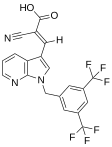
The WHO entry describes suvomipic as “(2E)-3-(1-{[3,5-bis(trifluoromethyl)phenyl]methyl}-1H-pyrrolo[2,3-b]pyridin-3-yl)-2-cyanoprop-2-enoic acid,” gives the formula C₂₀H₁₁F₆N₃O₂ and CAS Registry Number 2260696-63-5, and classifies it as a mitochondrial pyruvate carrier inhibitor. PubChem CID 137374808 and NCATS Inxight Drugs associate those identifiers with JXL069/JXL-069.134
The chemical name also matches the JXL069 entry in the peer-reviewed 2021 paper Development of Novel Mitochondrial Pyruvate Carrier Inhibitors to Treat Hair Loss. In that paper, JXL069 is a 7-azaindole analogue within a UCLA medicinal-chemistry program studying MPC inhibition for hair-growth applications.5
None of this requires a guess. The identifiers converge on the same molecule. What would require a guess is adding PP405 to that chain without a Pelage disclosure, trial-registry synonym, regulatory filing, or authenticated reference standard.
Inspect the proposed suvomipic structure
Move across the figure to tilt it, use the evidence tabs, or open the linked 3D model.
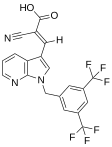
The WHO proposed INN entry and public chemical databases align on the structure, formula, and CAS number.
Compound profile
- Other names
- Suvomipic; JXL069; JXL-069. PP405 is Pelage’s development code and is not a confirmed chemical synonym.
- Route of administration
- Pelage’s PP405, which has not been confirmed as suvomipic, was studied by topical administration as a gel to the scalp[1][2].
- Drug class
- Mitochondrial pyruvate carrier (MPC) inhibitor. MPC inhibition can increase lactate dehydrogenase activity indirectly; it is not established as a direct enzyme stimulant.
- IUPAC name
- (2E)-3-(1-{[3,5-bis(trifluoromethyl)phenyl]methyl}-1H-pyrrolo[2,3-b]pyridin-3-yl)-2-cyanoprop-2-enoic acid
- Formula
- C20H11F6N3O2
- Molar mass
- 439.317 g·mol−1
Why the proposed name is still a major development
WHO’s guidance on International Nonproprietary Names explains that an application is made by a manufacturer or inventor, reviewed by experts, published as a proposed INN for comments, and only later, if objections are resolved, published as a recommended INN. The system is meant to give a well-defined pharmaceutical substance a globally recognizable generic name.2
So this is not merely a fresh nickname invented on a forum. Someone with a legitimate development interest supplied enough chemical and pharmacological information for JXL069 to enter a formal pharmaceutical-naming process. That is meaningful evidence that the molecule belongs to an active development story.
What the process does not publicly disclose in Proposed List 135 is the applicant’s identity or the development code attached to the submission. The name strengthens the PP405 hypothesis; it does not reveal who filed it or why.
Why Pelage’s PP405 is the obvious program to suspect
JXL069 came from the relevant UCLA scientific program. The 2021 medicinal-chemistry paper was authored by researchers connected to the discoveries that ultimately underpinned Pelage, and UCLA later announced that the hair-growth technology from the Christofk, Lowry, and Jung laboratories had been licensed to Pelage.56
Pelage describes PP405 as a topically applied small molecule based on a metabolic switch in hair-follicle stem cells. Its public explanation also identifies PP405 as an MPC inhibitor designed to reactivate dormant follicles. That gives JXL069 and PP405 the same broad research origin, therapeutic area, and molecular target.78
Consider the timing as well. JXL069 receives a proposed pharmaceutical name while PP405 advances through clinical development. Occam’s razor points toward a single program. But a simple explanation is not automatically a proven one, especially when the same laboratories and patent families contain many related MPC inhibitors.
- Same scientific neighborhoodUCLA hair-follicle metabolism research and overlapping inventors.
- Same broad mechanismSmall-molecule inhibition of the mitochondrial pyruvate carrier.
- Same disease areaA topical approach being developed for hair loss.
- Missing bridgeNo primary document naming suvomipic or CAS 2260696-63-5 as PP405.
Why the public record still stops short of PP405
The official ClinicalTrials.gov record for NCT06393452 identifies the investigational intervention as PP405 0.05% Topical Gel and describes it as an MPC inhibitor. It does not provide a chemical name, formula, CAS number, PubChem identifier, or suvomipic/JXL069 synonym.9
PP405 is Pelage’s sponsor-assigned development code, but public sources use that code at more than one level. New York Magazine reports that the researchers named their drug PP405 after the Los Angeles 405 freeway. Pelage describes PP405 as both its lead program and a novel topical small molecule. ClinicalTrials.gov names the intervention PP405 0.05% Topical Gel while a pharmacokinetic endpoint measures PP405 in plasma. The public record therefore does not establish whether Pelage uses the code only for the active drug substance, for the finished investigational product, or for both in different contexts.12109
For clarity, this article treats PP405 as Pelage’s development-program and clinical-product designation, not as a proven chemical synonym. The narrower molecular question is whether suvomipic is the active drug substance inside PP405.
Pelage likewise continued to use the PP405 code in its 2026 American Academy of Dermatology announcement and its October 2025 financing announcement. Neither announcement adopts suvomipic or identifies CAS 2260696-63-5.1011
The strongest public language pushing the other way comes from New York Magazine’s detailed PP405 feature. Co-inventor William Lowry said he could almost guarantee that Reddit users experimenting with a JXL compound were not treating themselves with PP405. Pelage chief medical officer Christina Weng said PP405’s structure “has not been disclosed” and rejected online products claiming to be PP405 or an equivalent.12
Those statements can be read in more than one way. One defensible reading is that they distinguish Pelage’s complete clinical drug product, including its controlled formulation, manufacturing, impurities, packaging, and dosing, from an outside powder in a solvent. On that reading, a vendor could have real JXL069 and still not have Pelage’s PP405 clinical product. The other reading is that the active molecule itself differs from JXL069. Because Weng specifically referred to the compound’s undisclosed structure, the formulation explanation cannot be treated as the only or most likely meaning. Until Pelage clarifies the name, both readings remain open.
The JXL082, 3HP, and PP30 theories show how the right family can still yield the wrong molecule
Before JXL069 became the leading theory, EveryChem sold a JXL082 0.05% gel in the context of speculation that JXL082 might be PP405. JXL082 was not a random choice: it came from the same medicinal-chemistry lineage and shared the relevant MPC mechanism. The identity was never confirmed.13
Attention later shifted to an EveryChem 3HP gel and a separate PP30 gel, again at nominally about 0.05%. A community deep dive correctly separated those products from authenticated PP405 and warned that PP405 trial findings cannot simply be transferred to PP30.141516
What public patents do not reveal is whether Pelage formally rejected PP30 or 3HP, why a particular candidate advanced, or whether either compound had another purpose. A candidate can lose out because of potency, selectivity, permeability, stability, synthesis, formulation, intellectual-property strategy, or dozens of other factors that are invisible outside the company.
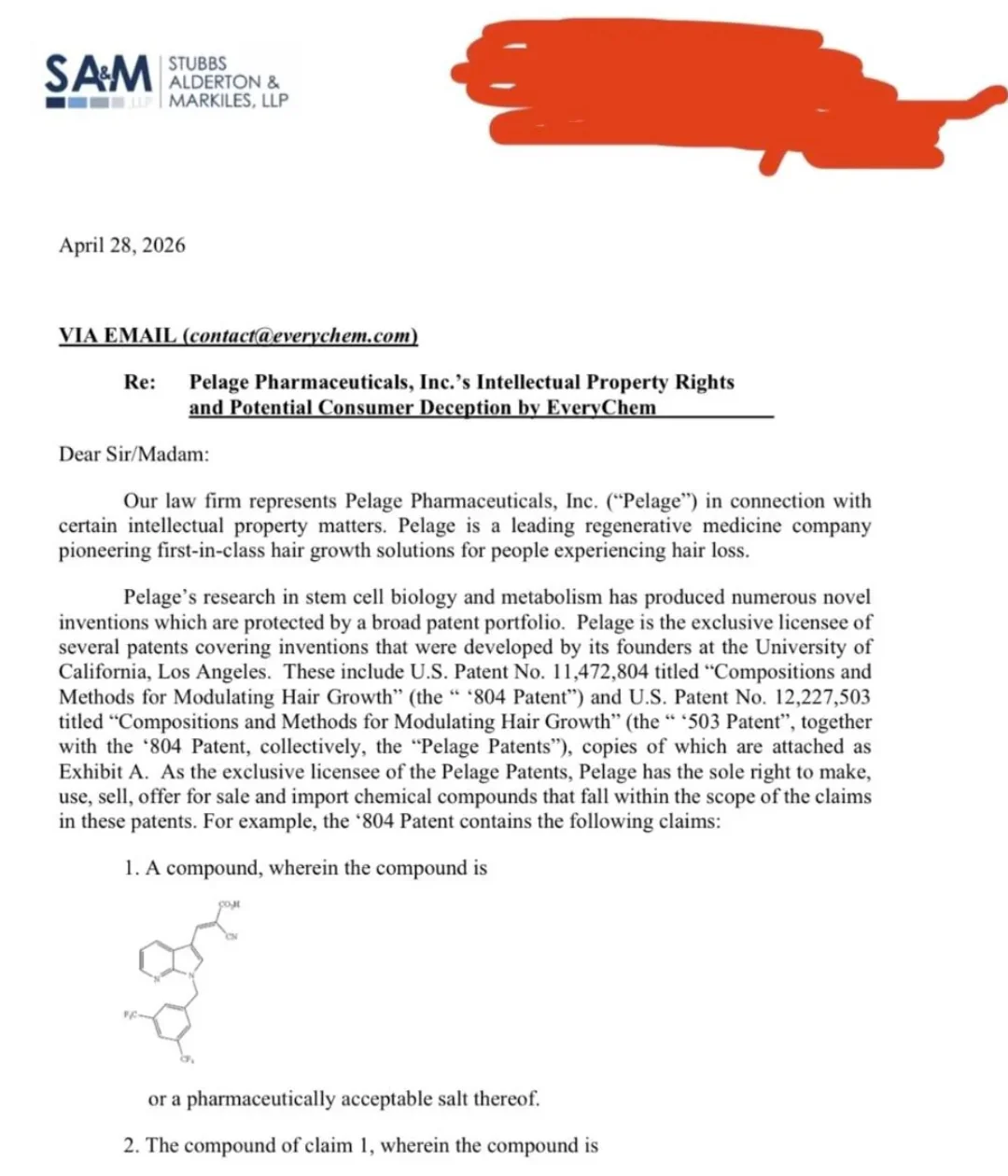
A separate Reddit discussion reported that Umbrella Labs and EveryChem received cease-and-desist letters. A reader-supplied excerpt dated April 28, 2026 adds a more concrete piece of circumstantial evidence. In the visible page, counsel writes that it represents Pelage, states that Pelage is the exclusive licensee of U.S. Patents 11,472,804 and 12,227,503, and reproduces claim 1 of the ’804 patent. The structure in that claim is the same structure the patent identifies as JXL069, now proposed as suvomipic. Assuming the supplied excerpt is authentic, it shows Pelage taking an active commercial and intellectual-property interest in a patent claim that specifically covers JXL069.173031
That can reasonably be counted as evidence that Pelage was concerned enough about EveryChem’s PP405-related activity to intervene. It still does not say that JXL069 is PP405’s active drug substance. An exclusive licensee can assert a patent against any covered compound, including one that is not its clinical candidate, and the letter’s subject also raises potential consumer deception. The concern could involve patent rights, use of the PP405 name, equivalence claims, uncertainty about what buyers would receive, or several of those issues at once. The excerpt strengthens the circumstantial case, but it does not supply the missing equals sign.3031
 Open full size
 What the EveryChem analytical documents can and cannot establish
A later Reddit comparison of EveryChem’s product data and NMR PDFs pointed to real inconsistencies between product-page metadata and attached analytical documents. The linked files include a 3HP proton NMR spectrum, a 3HP qNMR report, a PP30 proton NMR spectrum, and a PP30 qNMR report.1819202122
As described in those documents, the 3HP spectrum is reasonably compatible with the assigned hydroxypropyl ester and the PP30 spectrum with the assigned acetyloxyethyl ester. The qNMR reports state 99.4% and 99.6% purity, respectively, while relying on assumed sample molecular weights. Both also contain “Bromantane” near the top, apparently a template or administrative carryover.
That evidence can support consistency with a named submitted sample. It cannot independently discover a molecular formula, establish that either compound is PP405, or show that every finished dispenser contains the tested lot at the advertised concentration. The public set also lacks a complete finished-product package: mass spectrometry, impurity and residual-solvent characterization, microbial testing, validated stability, and blinded chain-of-custody retail sampling.
| Evidence | Can support | Cannot establish by itself |
|---|---|---|
| Proton NMR | Consistency with an assigned structure | PP405 identity or finished-gel dose |
| qNMR with assumed molecular weight | Estimated purity for the submitted sample | Independent molecular formula |
| Vendor-posted certificate | What a named sample reportedly contained | Every retail unit or regulator-grade chain of custody |
The patents disclose many plausible compounds, not one obvious answer
The University of California and Pelage patent landscape is intentionally broad. US20240327400A1 and WO2023130024A1 describe multiple MPC inhibitors, structural branches, esters, and treatment strategies. Earlier families such as US11312714B2 provide still more context for the underlying program.232425
That breadth is normal. A pharmaceutical patent may include parent acids, prodrugs, backup candidates, comparative examples, and compounds that never leave preclinical work. Being named in the right patent family is evidence of scientific proximity, not proof of clinical selection.
The same abundance cuts both ways: JXL069 is a credible PP405 candidate because it lives in the right chemical and biological neighborhood, but the neighborhood contains too many other molecules for proximity alone to settle the address.
The Anagen reports support JXL069 in the submitted samples, but they do not establish PP405’s identity
Anagen markets a JXL069 solution at 0.5 mg/mL, equivalent to 0.05% weight per volume. Its page lists CAS 2260696-63-5, formula C₂₀H₁₁F₆N₃O₂, and molecular weight 439.31, while treating PP405 as a community term rather than claiming a formally verified one-to-one identity.26
The company also links a public folder of watermarked laboratory reports. In those vendor-commissioned files, MZ Biolabs reports 99.55% purity for a submitted powder and a measured monoisotopic mass of 439.08 Da, matching the expected value. A separate Nutri Analytical report gives 99.78% relative chromatographic area for the named powder lot.27
The finished solution reports are also informative but not identical: Nutri Analytical reports 0.490 mg/mL against a 0.5 mg/mL label claim, while MZ Biolabs reports 0.535 mg/mL. Those values are roughly 2% below and 7% above the label claim. They support the presence of about the claimed amount in the submitted samples; they should not be compressed into a universal “within 5%” statement.
Chromatography plus mass spectrometry is stronger identity evidence than a qNMR calculation that starts with an assumed molecular weight. Even so, a laboratory can identify JXL069 without knowing Pelage’s confidential PP405 code. The reports do not authenticate PP405, establish every retail bottle’s contents, validate shelf-life stability, or demonstrate safety or hair growth in people.
Even an identical active molecule would not make outside products equivalent to Pelage’s gel
Imagine Pelage confirms tomorrow that suvomipic is the active drug substance inside PP405. That would answer the molecular-identity question. It would not show that an Anagen solution, an EveryChem gel, or a homemade propylene-glycol mixture behaves like the investigational product used in Pelage’s trials.
WHO explains that an International Nonproprietary Name identifies a pharmaceutical substance or active ingredient. Suvomipic therefore names the JXL069 substance, not Pelage’s complete topical gel. FDA guidance separately defines a drug substance as the active ingredient and a drug product as the finished dosage form that contains it. A drug product includes more than its active ingredient: vehicle, concentration, manufacturing process, impurity limits, particle state, pH, packaging, storage, stability, dosing device, release testing, and instructions all affect what reaches the scalp and how consistently.232
VDPHL01 makes the distinction concrete. Veradermics describes VDPHL01 as a proprietary extended-release oral minoxidil tablet: minoxidil is the known active ingredient, while the coded candidate includes a specific release technology and dosage form. That example does not prove PP405 follows the same naming convention. It does show why a sponsor code, active drug substance, and clinical drug product must be analyzed separately.33
The same logic explains how a gray-market seller could possess authentic JXL069 without possessing authentic PP405, even if Pelage later confirms that JXL069 is the active drug substance. Different solvent systems can change follicular penetration, irritation, degradation, local retention, and systemic exposure, and a vendor still would not have Pelage’s manufacturing controls or chain of custody.
The Phase 2a study evaluated Pelage’s controlled PP405 0.05% topical gel, not any product containing a related MPC inhibitor at the same nominal percentage. Pelage later reported no detectable systemic absorption in its clinical program; that formulation-specific observation cannot be assigned to another solvent system.910
The same boundary applies to efficacy. In a company release about its Phase 2a results, Pelage reported that 31% of men in a higher-hair-loss subgroup achieved more than a 20% density increase at week eight after four weeks of dosing, versus none on vehicle. That is a company-reported subgroup result for PP405; it is not evidence that JXL069 sold elsewhere is safe or effective.28
Mechanism alone cannot fill the gap either. The review Fifty Years of the Mitochondrial Pyruvate Carrier describes historical challenges involving MPC-inhibitor chemistry, selectivity, and stability. A compound can be real and correctly identified yet still be poorly formulated, degraded, inconsistently dosed, or unsuitable for unsupervised human use.29
What evidence would finally connect suvomipic to PP405?
The debate does not require another round of scaffold matching. It requires one direct, attributable document. Any of the following would materially change the conclusion:
- A Pelage disclosureA company announcement, presentation, paper, or FAQ describing PP405 as suvomipic or JXL069.
- A trial-registry synonymClinicalTrials.gov adding suvomipic, JXL069, or CAS 2260696-63-5 to the PP405 intervention.
- A regulatory or naming recordA filing that connects the PP405 code, the applicant, and the suvomipic substance.
- An authenticated analytical comparisonA verified PP405 reference substance matched to JXL069 with documented chain of custody.
Suvomipic is the strongest public PP405 candidate, but it is still a candidate
The WHO publication is the clearest development yet in the search for PP405’s identity. It establishes that suvomipic is the proposed international name for the substance previously catalogued as JXL069. The chemical structure, formula, CAS number, pharmacological target, and public database records align.
The circumstances make PP405 the obvious program to suspect: shared UCLA origins, the same broad MPC mechanism, the same hair-loss objective, overlapping patent territory, and a proposed pharmaceutical name appearing while Pelage advances its compound. Dismissing the theory as baseless speculation is no longer reasonable.
Declaring the identity proven would be equally premature. WHO does not name Pelage or PP405; Pelage and ClinicalTrials.gov still use only the PP405 code; company representatives previously said the structure had not been disclosed; and the relevant patents contain many related candidates.
The accurate sentence is therefore narrow: JXL069 is suvomipic. Suvomipic may well be PP405, but no public primary source has yet supplied the final equals sign.
Sources & further reading
We prioritize official labels, professional medical organizations, and peer-reviewed literature. Sources accessed for this guide on .
- 1Proposed International Nonproprietary Names: List 135
World Health Organization
- 2Guidance on International Nonproprietary Names
World Health Organization
- 3CID 137374808: JXL069 chemical record
PubChem, National Library of Medicine
- 4JXL-069, UNII NPC95AG9EF
NCATS Inxight Drugs
- 5Development of Novel Mitochondrial Pyruvate Carrier Inhibitors to Treat Hair Loss
Journal of Medicinal Chemistry via PubMed Central
- 6
- 7PP405 science and development overview
Pelage Pharmaceuticals
- 8What is PP405 and how does it work?
Pelage Pharmaceuticals
- 9
- 10PP405 and its Impact on Follicular Regeneration to be Presented at AAD 2026
Pelage Pharmaceuticals
- 11$120 Million Series B Financing to Advance PP405
Pelage Pharmaceuticals
- 12The Experimental Drug That Could Reverse Baldness
New York Magazine
- 13
- 143HP gel dispenser product page
EveryChem
- 15PP30 gel dispenser product page
EveryChem
- 16Did a deep dive on EveryChem’s PP405
Reddit, r/HairlossResearch
- 17Community report concerning cease-and-desist letters
Reddit, r/HairlossResearch
- 18EveryChem 3HP / PP30 page data versus NMR PDFs
Reddit, r/HairlossResearch
- 193HP proton nuclear magnetic resonance spectrum
EveryChem analysis document
- 203HP quantitative nuclear magnetic resonance report
EveryChem analysis document
- 21PP30 proton nuclear magnetic resonance spectrum
EveryChem analysis document
- 22PP30 quantitative nuclear magnetic resonance report
EveryChem analysis document
- 23
- 24WO2023130024A1: Compounds for treating hair loss
Google Patents
- 25US11312714B2: Modulation of hair growth
Google Patents
- 26JXL069 solution product and testing overview
Anagen Inc.
- 27Watermarked JXL069 laboratory reports
Anagen Inc. public Dropbox folder
- 28Positive Phase 2a Clinical Trial Results for PP405
Pelage Pharmaceuticals
- 29Fifty Years of the Mitochondrial Pyruvate Carrier: New Insights into its Structure, Function, and Inhibition
Biochemical Journal via PubMed Central
- 30April 28, 2026 letter excerpt addressed to EveryChem
Reader-supplied document image
- 31US11472804B2: Claim 1 and JXL069 compound identification
Google Patents
- 32Drug substance and drug product definitions
U.S. Food and Drug Administration
- 33


Comments and replies
The discussion about Is JXL069, Now Proposed as Suvomipic, Actually Pelage’s PP405? is public. Everyone can read every thread and reply. Signed-in members can comment, reply, and mention people with their @handle.