What GT20029 actually is, and what its phase 2 trial really showed
Most hair-loss drugs either cut the supply of DHT or sit in front of the receptor it switches on. GT20029 tries a third thing. It destroys the receptor.
Uses the best matching voice on your device. No subscription or per-listen fee.
 Open full size
 Key takeaways
- Every drug for male pattern hair loss is aimed at one thing: how much DHT gets to sit in the androgen receptor. There are three ways to attack that, and GT20029 uses the newest one.
- Finasteride and dutasteride cut the raw material. Clascoterone, RU58841 and pyrilutamide sit in the receptor so DHT cannot. GT20029 tags the receptor itself for destruction, then lets go and does it again.
- Two of the four GT20029 arms beat their matched placebo at week 12. Two did not. The best result was 11.94 extra hairs per square centimeter on 1.0% twice weekly against 4.57 on its placebo, a difference of 7.36 hairs at p = 0.023.
- The two placebo groups in the same trial gained 10.10 and 4.57 hairs per square centimeter, and one of them swung by twelve hairs between week 6 and week 12. That is roughly the size of the winning margins, which tells you how much noise a 30-man arm carries.
- Tolerability over twelve weeks was good. The main drug-related complaint was itching where the spray went, blood levels of the drug stayed very low, and nobody in a GT20029 arm dropped out.
- The paper’s discussion section overstates its own results, and the group sizes do not match across its three tables.
- GT20029 is not approved anywhere, is not available to buy, and has never been tested for longer than twelve weeks or outside China.
Every hair-loss drug is trying to break the same handshake
Male pattern hair loss runs on a two-part system. There is a hormone called dihydrotestosterone, almost always shortened to DHT, and there is a protein inside your cells called the androgen receptor, usually shortened to AR. On their own, neither one does anything to your hair. The damage happens when they meet. DHT slots into the androgen receptor, the receptor changes shape, and that new shape goes on to switch genes on and off inside the cells that tell a hair follicle how big to grow and how long to keep growing.414
In a scalp follicle that carries the genetic susceptibility, the instruction that comes out the other end is roughly “grow smaller and stop sooner.” Repeat that over many growth cycles and a thick, dark, long-growing hair is gradually replaced by a shorter, finer, paler one, and eventually by one you cannot really see. That process is called miniaturization, and it is what people are actually watching when they say their crown is thinning.4
So the entire pharmaceutical effort in this field, going back to the 1990s, comes down to one sentence. Reduce how much DHT gets to interact with the androgen receptor. That is the goal. Everything else is a question of where in the chain you decide to interfere.
There are three places you can interfere, and it is worth laying them out before GT20029 enters the story, because GT20029 only makes sense as the third one.
| Strategy | What it does | Drugs that work this way |
|---|---|---|
| Cut the supply | Stop the body converting testosterone into DHT, so there is less DHT around to bind anything | Finasteride, dutasteride |
| Block the receptor | Put a molecule into the receptor’s binding pocket so DHT arrives and finds the seat taken | Clascoterone, RU58841, pyrilutamide, spironolactone |
| Destroy the receptor | Tag the receptor protein itself for disposal, so there is nothing left for DHT to bind | GT20029 |
Where DHT actually comes from, step by step
You cannot judge what finasteride does, or why anyone bothered inventing something like GT20029, without knowing where DHT comes from. The chain is shorter than most people expect, and one link in it matters more than all the others.
It starts with cholesterol. The same cholesterol that comes up at your annual physical is the raw material for every steroid hormone your body makes, including cortisol, estrogen, and testosterone. A shuttle protein drags cholesterol into the mitochondria of hormone-producing cells, where an enzyme clips off its tail to make a molecule called pregnenolone. That clipping step is the slowest one in the whole system, so it sets the pace for everything downstream.5
Pregnenolone then passes down a short assembly line. It becomes 17-hydroxypregnenolone, then DHEA, then androstenedione, then testosterone. Most of that happens in the Leydig cells of the testes, which supply over 95% of the testosterone circulating in a man’s blood. The adrenal glands contribute the small remainder, largely by way of precursors that get converted elsewhere in the body.5
Here is the part that matters. Testosterone is not the villain in scalp hair loss. It is the raw material the villain is made from. In certain tissues, including the skin of your scalp, an enzyme called 5-alpha reductase grabs testosterone and makes one specific chemical edit. Testosterone has a double bond in one of its four rings. The enzyme uses a helper molecule called NADPH to break that bond and add hydrogen across it. That single edit turns testosterone into DHT, and it cannot be undone. The enzyme does not run backwards.6
On paper the two molecules look almost identical. But that edit changes how the molecule sits inside the androgen receptor. DHT binds the receptor roughly twice as tightly as testosterone does and, more importantly, it lets go about five times more slowly. A hormone that stays in the pocket longer keeps the switch held down longer, and the practical result is that DHT is something like ten times more powerful a signal than the testosterone it came from.6
What makes this hard to reason about is that DHT barely behaves like a circulating hormone at all. Only about 4% of your testosterone is ever converted to DHT, and blood DHT sits at roughly a tenth of blood testosterone. Most of the DHT that matters is manufactured on site, inside the target tissue, and acts right there. Local concentrations can run up to ten times higher than the local testosterone concentration. That is why your scalp can have a DHT problem a blood test would not show you, and it is why aiming a treatment at the scalp is a coherent idea in the first place.65
- CholesterolThe starting material for every steroid hormone in the body.
- Pregnenolone, DHEA, androstenedioneA short relay of intermediate molecules on the way to the sex hormones.
- TestosteroneMade mainly in the testes. On its own it is a relatively weak signal at the androgen receptor.
- 5-alpha reductaseThe enzyme that makes the one-way edit. This is the link every DHT-lowering drug attacks.
- DHTBinds tighter, lets go slower, holds the switch down longer, and is made mostly inside the tissue where it acts.
Cutting the supply: finasteride, dutasteride, and the ceiling they hit
Once you know one enzyme performs the conversion, the drug idea writes itself. Jam the enzyme. That is what finasteride and dutasteride do. They are not hormones, they do not touch the androgen receptor, and they do not remove testosterone. They disable 5-alpha reductase so less testosterone gets converted, and DHT falls.7
The reason anyone thought to try this is one of the better stories in medicine. In 1974, Julianne Imperato-McGinley and colleagues published a study of a large family group in the Dominican Republic in which some members were born without a working copy of one form of 5-alpha reductase. They made testosterone normally but made very little DHT. As adults they had scant or absent beard growth, no receding temples, no male pattern baldness, no acne, and a small or absent prostate. That natural experiment told drug companies almost exactly what a DHT blocker would and would not do, roughly two decades before one existed.11
Two forms of the enzyme matter for androgens. Type 1 dominates in the sebaceous glands of the skin, including scalp skin, and in the liver, and accounts for about a third of the DHT in your blood. Type 2 sits in the prostate, the seminal vesicles, and the hair follicle, and accounts for the other two thirds. When researchers stained human scalp to see where each one lives, type 2 showed up inside the follicle structures themselves while type 1 stained intensely in the sebaceous glands and not within follicles at all.710
Finasteride goes after type 2, and its own label states it has 100-fold selectivity for type 2 over type 1. Dutasteride hits both, which is why it drives DHT down much further. In practice, at 1 mg a day finasteride cuts scalp skin DHT by about 64% and blood DHT by about 71%. Dutasteride at 0.5 mg a day cuts blood DHT by about 94% at one year.98
Finasteride 1 mg has been approved for male pattern hair loss in men since 1997. Dutasteride is approved in most countries only for prostate enlargement, so using it for hair is a prescriber decision rather than a labeled indication, with the notable exceptions of South Korea and Japan where it does carry a hair-loss approval.78
This approach works and it has decades of evidence behind it. It also has two structural limits, and those limits are the reason people keep inventing new drugs.
The first is that you cannot get to zero. Finasteride leaves roughly a third of scalp DHT intact by design, because it is deliberately selective away from the type 1 enzyme that dominates scalp sebaceous glands. Even dutasteride’s near-total blockade cannot empty the receptor, because testosterone itself still binds it. If your follicles are unusually sensitive to androgen, what is left over can be enough to keep the miniaturization running.79
The second is that a tablet acts on your whole body. It lowers DHT everywhere, and DHT does other jobs. That is the origin of the side effect conversation around finasteride, and it is why so much recent development has aimed at doing something to the scalp without doing it to everything else. Topical finasteride is one answer, and there is real phase 3 evidence behind a 0.25% spray tested across 45 European sites, which produced a hair count gain broadly similar to the oral drug while keeping peak blood levels more than a hundred times lower. There is still no FDA-approved topical finasteride product in the United States, and in April 2025 the FDA issued an alert about compounded versions after receiving reports of the same systemic effects people take a topical to avoid.1312
Blocking the receptor: taking the parking space before DHT arrives
If you cannot get rid of all the DHT, the next idea is to make sure it has nowhere to dock. That means going after the androgen receptor itself.
It helps to know what the receptor actually is. It is a large protein, about 920 amino acids long, built from a gene on the X chromosome. Most of the time it sits idle in the fluid of the cell, held in a ready state by a chaperone protein called HSP90 whose job is to keep the binding pocket open and primed. When DHT slides into that pocket, the receptor changes shape, sheds its chaperone, exposes a tag that gets it carried into the nucleus, pairs up with a second copy of itself, clamps onto specific stretches of DNA called androgen response elements, and recruits the machinery that turns genes on.161718
That is the whole job. The receptor is a switch that only works when something is sitting in its pocket. Everything downstream, good and bad, follows from whether that pocket is occupied.
In hair, the receptor that matters sits in the dermal papilla, a small ball of cells at the base of each follicle that acts as the follicle’s control room. Dermal papilla cells from androgen-sensitive follicles carry higher levels of androgen receptor than cells from unaffected scalp. And here is the genuinely strange part, which researchers call the androgen paradox. The same hormone, acting through the same receptor, tells a beard follicle to grow bigger and a susceptible scalp follicle to grow smaller. Eyelashes appear to ignore it entirely.14
The difference is not in the hormone and not in the receptor. It is in what those particular dermal papilla cells are programmed to release when the switch is flipped. Androgen makes beard dermal papilla cells secrete IGF-1, a growth signal. It makes balding scalp dermal papilla cells secrete TGF-beta1, TGF-beta2, DKK-1 and IL-6, which are inhibitory signals. Same switch, opposite wiring, decided during fetal development.1514
A receptor blocker, also called an antiandrogen, is a molecule shaped closely enough to fit the pocket but not shaped correctly to flip the switch. It parks in the space so DHT cannot. Antiandrogens split into two families, and the split matters more than you would guess.
- Steroidal antiandrogensBuilt on the same four-ring steroid skeleton as the hormones themselves. Cyproterone acetate and spironolactone are the familiar examples, and clascoterone belongs here too, since it is a modified version of a natural steroid.
- Non-steroidal antiandrogensBuilt on a completely different chemical frame that happens to fit the pocket. Bicalutamide and enzalutamide in cancer medicine, RU58841 and pyrilutamide in the hair world.
Why the shape of an antiandrogen decides its side effects
The reason the steroidal and non-steroidal distinction matters is that your body has several receptors that all evolved from a common ancestor and all still recognize the same basic four-ring steroid shape. There is one for progesterone, one for cortisol, and one for aldosterone, the hormone that controls salt and water balance. They are cousins of the androgen receptor and their binding pockets are similar.
So a steroidal antiandrogen, built on that same skeleton, gets recognized by the cousins too. Cyproterone acetate is the clearest case. Its reported binding affinities run around 90% at the progesterone receptor against about 6% at the androgen receptor, which means it binds the progesterone receptor roughly fifteen times more avidly than the receptor it is prescribed to block. Spironolactone was designed for the aldosterone receptor, is still used for heart failure and blood pressure, and blocks the androgen receptor as a side activity, which is why in men it can raise potassium, grow breast tissue, and reduce libido. Neither is a clean tool, and neither is used for male pattern hair loss in men in most of the world.1920
A non-steroidal antiandrogen sidesteps the problem by not looking like a steroid at all. It is built on a different chemical frame, typically anilide or thiohydantoin chemistry, shaped through years of medicinal chemistry to fit the androgen receptor pocket and very little else. That gives much cleaner selectivity, with no progestogenic, glucocorticoid, or mineralocorticoid activity riding along. RU58841 and pyrilutamide both come from this family.21
Clascoterone is the interesting exception, and it is routinely miscategorised online. It is a steroid, a modified form of the natural hormone precursor cortexolone, so it carries exactly the cross-reactivity risk described above. Its answer is not a different scaffold but a different strategy: it is built to be broken down quickly once it leaves the skin, so the antiandrogen effect stays local. That strategy is only partly successful. Its acne label still carries a warning for temporary suppression of the adrenal stress-hormone axis, which is the kind of side effect a steroid scaffold produces and a non-steroidal one does not.22
Three names come up constantly in hair-loss discussion, and they sit at three very different levels of legitimacy. It is worth being precise about each, because online they get treated as though they were interchangeable.222324252628
| Molecule | What it is | Where it actually stands |
|---|---|---|
| Clascoterone (CB-03-01) | A steroidal androgen receptor blocker built to act locally. Its FDA label reports blood levels of its main metabolite at or below the limit of measurement, though it also carries a warning for temporary suppression of the adrenal stress-hormone axis | FDA approved since August 2020 as Winlevi, a 1% cream, but only for acne. The scalp solution for hair loss, Breezula, ran a 1,465-man phase 3 program across two trials and reported positive topline results in December 2025, with a US filing planned for early 2027. Not yet approved for hair loss anywhere |
| RU58841 | A non-steroidal antiandrogen from a 1990s Roussel Uclaf program, later carried by ProStrakan | Development was abandoned and it was never approved anywhere. Early human studies were reportedly run but never published, so there is no peer-reviewed human efficacy or safety data at all. It is sold today only as an unregulated research chemical of unverified purity |
| Pyrilutamide (KX-826) | A topical non-steroidal androgen receptor antagonist, and Kintor’s other hair-loss molecule alongside GT20029 | Its first Chinese phase 3, at 0.5% twice daily in 740 men, failed to beat placebo in 2023. A second pivotal trial adding a 1.0% strength reported success in March 2026, with 10.65 more hairs per square centimeter than placebo. A Chinese marketing application is being pursued. Not approved anywhere |
The problem with blocking: it is a fight you have to keep winning
A receptor blocker works by competition. It and DHT are both trying to get into the same pocket, and which one is sitting there at any moment depends on how much of each is nearby and how tightly each holds on. That has an unavoidable consequence. The moment the blocker’s local concentration drops, DHT starts winning again.
Remember what the blocker is up against. DHT binds about twice as tightly as testosterone and lets go about five times more slowly, and the tissue is manufacturing it on site, continuously. You are not trying to beat DHT once. You are trying to beat it every hour of every day, inside a structure buried several millimeters under the skin, using a liquid you rubbed on the outside.6
That is why the serious topical antiandrogens are all twice-daily drugs. Clascoterone’s phase 3 used 1.5 mL of 5% solution twice a day, and pyrilutamide’s pivotal trials dosed twice daily as well. Missing doses hands the receptor back. Compare that with a 5-alpha reductase inhibitor, where the enzyme stays disabled well after the drug itself has cleared the body, and you can see why adherence is a much bigger deal for a blocker than for a supply-cutter.2428
The pyrilutamide story makes the point better than any argument could. Kintor ran a 740-man phase 3 in China at 0.5% twice daily. Hair counts rose from baseline with high statistical significance, and the drug still did not beat placebo. The company went back, added a 1.0% strength, and ran a second pivotal trial. That one worked, reporting 10.65 more hairs per square centimeter than placebo at the higher strength. The molecule did not change. The concentration did.2728
There is a second, more conceptual issue. Blocking a receptor leaves the receptor sitting there. Proteins in a cell often do more than one thing, and a receptor occupied by a blocker is still physically present, still able to interact with other proteins, and still subject to whatever the cell does to compensate, which can include simply making more of it. If you want to be certain a switch cannot be flipped, there is a more thorough option than covering it up.30
Destroying the receptor: what a PROTAC is, in plain words
Your cells already have a disposal system for proteins. Nothing inside a cell lasts forever, and there is a permanent recycling operation running in the background that finds proteins which are damaged, misfolded, or no longer needed and takes them apart into amino acids so the pieces can be reused.
The system works by labeling. A small protein called ubiquitin is the label. A relay of enzymes passes ubiquitin along, and the last one in the relay, called an E3 ligase, attaches it to a specific target. Attach a chain of them and you have written the cellular equivalent of “dispose of this.” A large barrel-shaped machine called the 26S proteasome recognizes that label, pulls the tagged protein inside, and takes it apart. Working this system out won the 2004 Nobel Prize in Chemistry.3329
A PROTAC hijacks that system on purpose. The name stands for proteolysis targeting chimera, which is a mouthful but describes exactly what it is. Proteolysis means protein destruction. A chimera, in chemistry, is a molecule stitched together from two parts that were never naturally connected. The idea was first published in 2001 by Kathleen Sakamoto, Craig Crews, and Raymond Deshaies.29
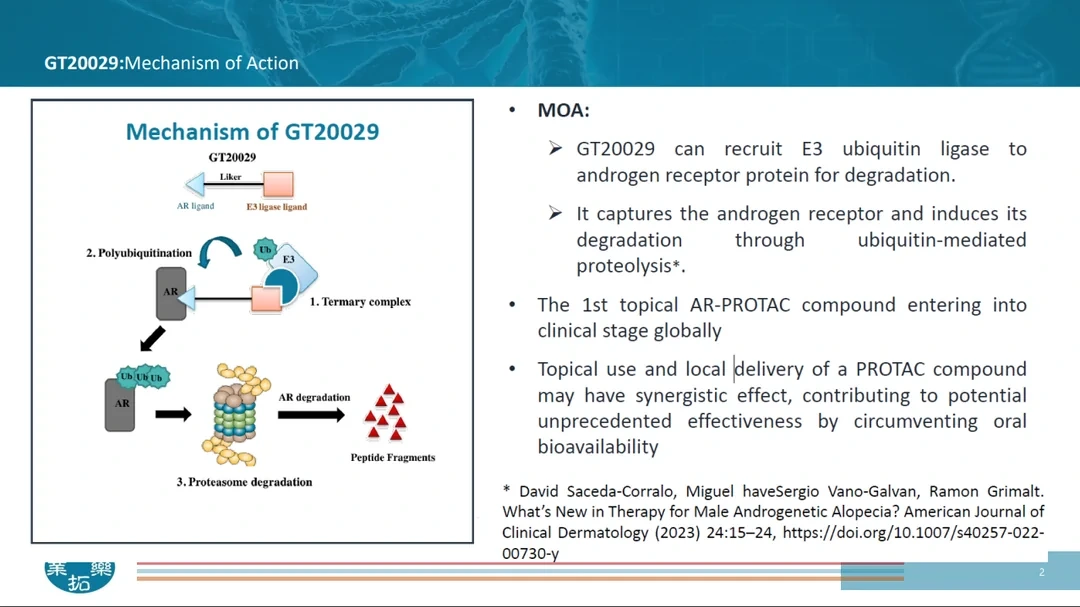
A PROTAC has exactly three pieces. At one end is a grabber that binds the protein you want gone, in this case the androgen receptor. At the other end is a grabber that binds one of the cell’s E3 ligases. In the middle is a linker holding the two ends at the right distance and angle. The molecule does not block anything and does not need to. All it does is physically drag the target and the labeling enzyme close enough together that the enzyme does what it always does and tags whatever is in front of it.2931
Then comes the part that makes this class genuinely different from a blocker. Once the receptor has been tagged and hauled off to the proteasome, the PROTAC molecule lets go. It has not been consumed. It is free to find another androgen receptor and do it again, and again. Chemists call this event-driven rather than occupancy-driven pharmacology, and it means one drug molecule can destroy many target proteins rather than neutralizing one at a time.30
Two practical consequences follow. You can potentially use less drug, and the effect outlasts the drug, because what you leave behind is not a molecule sitting in a pocket but an absence of protein that the cell now has to rebuild from scratch. That is the entire argument for testing a hair treatment on a twice-weekly schedule, which would be an absurd proposition for a competitive blocker.30
This is not a theoretical technology any more. In May 2026 the FDA approved vepdegestrant, an oral PROTAC that degrades the estrogen receptor, for a form of advanced breast cancer. It is the first protein degrader of this kind approved anywhere, and it establishes that the mechanism can survive contact with a regulator.34
 Open full size
 - 01The PROTAC grabs the receptor
One end of the molecule binds the androgen receptor, the same protein a normal antiandrogen would sit inside.
- 02It grabs a labeling enzyme too
The other end binds an E3 ligase, one of the cell’s own proteins whose job is to attach disposal tags.
- 03The tag goes on
Held close together, the enzyme attaches a chain of ubiquitin to the receptor, marking it for destruction.
- 04The proteasome takes it apart
The cell’s recycling machine recognizes the tag, pulls the receptor in, and breaks it down. That receptor is gone, not blocked.
- 05The PROTAC walks away and repeats
The drug molecule is released intact and goes on to tag the next receptor. One molecule can destroy many.
So what is GT20029?
GT20029 is a topical androgen receptor PROTAC developed by Kintor Pharmaceutical, a company based in Suzhou, China and listed in Hong Kong since 2020. Its stated mechanism is exactly what the previous section described: pull the androgen receptor into contact with an E3 ubiquitin ligase, get it tagged, let the proteasome destroy it, and do all of that locally in the skin. Kintor describes it as the world’s first topical androgen receptor degrader to reach clinical trials. That framing comes from the company’s own announcements rather than from a regulator or a registry, though no competing topical AR degrader in clinical development has surfaced to contradict it.353638
The formulation is deliberately simple. Besides the active compound, the solution contains dehydrated alcohol, propylene glycol, polysorbate, and purified water. Anyone who has used topical minoxidil will recognize that list, because it is the standard toolkit for getting a compound that dislikes water to spread across a scalp and get into skin.1
It was tested at two strengths, 0.5% and 1.0%, which work out to roughly 0.3 g and 0.6 g of drug in a 60 mL bottle. A dose is seven sprays, about one milliliter in total, applied to the thinning area.1
Kintor is also the company behind pyrilutamide, KX-826, which is a conventional topical receptor blocker rather than a degrader. Keeping the two apart matters, because they are constantly confused in online discussion and sometimes in press coverage. Pyrilutamide sits in the receptor. GT20029 removes the receptor. Same company, same target, two completely different ways at it. Kintor has reported that GT20029 produces much lower systemic exposure than pyrilutamide does, which is what you would hope for from a molecule designed to work catalytically and locally.3536
Before the trial described below, GT20029 went through phase 1 twice. A Chinese study ran from 2021 to 2022 in 95 healthy volunteers, applying the drug to a fixed patch of back skin. A US study, NCT05428449, enrolled 123 people across San Diego and Salt Lake City in 2022, combining single doses in healthy volunteers with fourteen days of repeat dosing, plus separate groups of men with hair loss and people with acne. Both were about safety, tolerability, and how much drug reaches the bloodstream rather than about hair.3837
The answer on blood levels was striking. In the Chinese study there was no detectable systemic exposure after a single application of the gel, with concentrations below the limit of quantification at most time points. In the US study, single-dose participants had zero systemic exposure, and even after fourteen days of repeat dosing peak plasma concentration reached at most 0.015 nanograms per milliliter. Side effects were mild application-site reactions: dryness, itching, rash, some skin flaking. Nothing serious.3836
How the phase 2 trial was built
The results people have been passing around come from a trial run across twelve hospitals in China between April 2023 and April 2024, registered as NCT06692465 and published in the Journal of Dermatological Treatment on 2 December 2025. It screened 225 men and enrolled 180.12
The design is the right one. Randomized means a computer decided who got what. Double blind means neither the men nor the doctors assessing them knew who was on the real drug. Placebo controlled means some men got an identical bottle containing everything except the active ingredient. Randomization was also stratified by each man’s starting ratio of thick to fine hairs, so the groups would not accidentally end up with different severity mixes.1
Where it gets unusual is the six arms. Most trials run two or three. This one split 180 men across two strengths at two schedules, each with its own matched placebo. That is a lot of arms for a small trial, and it is the single most important thing to understand about how to read the results, because it leaves only about thirty men in each cell.1
| Arm | Strength | How often |
|---|---|---|
| GT20029 0.5% QD | 0.5% | Once a day, every day |
| GT20029 1.0% QD | 1.0% | Once a day, every day |
| Placebo QD | None | Once a day, every day |
| GT20029 0.5% BIW | 0.5% | Twice a week |
| GT20029 1.0% BIW | 1.0% | Twice a week |
| Placebo BIW | None | Twice a week |
How the hairs were counted, and why the method matters
This is the part of a hair trial most people skip, and it is what separates a measurement from an impression.
The investigators picked a circular patch on the front edge of each man’s balding area, in the region between roughly ten o’clock and two o’clock if you look down at the top of the head. They clipped the hair in that patch to about one millimeter, so every hair including the short and fine ones could be seen and counted rather than hidden under longer hair lying across it.1
Then they tattooed a small semi-permanent ink dot in the patch. That dot is the reason the measurement means anything at all. It guarantees that at week 6 and week 12 the camera is pointed at the same square centimeter of scalp it saw on day one, rather than at a slightly different patch that happens to look better. If you have ever noticed a red or pink dot in a clinical trial scalp photo and wondered what it was, that is it.1
The patch was photographed with a dedicated dermatological imaging system at twenty times magnification, and software counted the hairs inside a defined area of 0.903 square centimeters, with results then reported per square centimeter. The headline number, target area hair count, includes only hairs at least 30 micrometers thick. Anything thinner is classed as vellus hair, the near-invisible fuzz everybody has, and excluded. That threshold matters, because a treatment that thickens invisible fuzz until it crosses the 30 micrometer line will register as a gain even though no new follicle appeared.142
A second measure, target area hair width, added up the thickness of all the hairs in the same patch. It answers a different and arguably more useful question, because it captures whether existing hairs are getting thicker rather than only whether more of them crossed a threshold.1
As for the men themselves: average age about 32, average body mass index about 25, and 96.7% Han Chinese. They were graded Hamilton-Norwood IIIv, IV, or V, which covers crown thinning from early through to substantial, with the front and crown thinning zones still separated by a band of hair. Average starting count in the measured patch was about 116 hairs per square centimeter. Anyone who had used topical minoxidil in the previous six months, or finasteride or dutasteride in the previous year, was excluded.1
What the trial found, including the parts that did not work
The main question was simple. After twelve weeks, how many more hairs were in the measured patch than at the start, and was that better than the same measurement in the men who got the placebo?
All four GT20029 arms gained hairs compared with their own starting point, and the abstract leads with that. But gaining hairs against your own baseline is a low bar in a hair trial, because the placebo groups gain hairs too. Clipping the area, photographing it under controlled light, and counting with software all tend to produce some apparent gain regardless of what is in the bottle. The number that matters is the comparison against the matched placebo, and there the picture splits down the middle.1
| Arm | Gain vs own baseline | Gain over matched placebo | 95% confidence interval | p-value |
|---|---|---|---|---|
| GT20029 0.5% once daily | +16.80 | +6.69 | 0.58 to 12.81 | 0.032 |
| GT20029 1.0% once daily | +13.08 | +2.98 | -3.30 to 9.26 | 0.351 |
| Placebo once daily | +10.10 | n/a | n/a | n/a |
| GT20029 0.5% twice weekly | +10.25 | +5.67 | -0.66 to 12.01 | 0.079 |
| GT20029 1.0% twice weekly | +11.94 | +7.36 | 1.03 to 13.69 | 0.023 |
| Placebo twice weekly | +4.57 | n/a | n/a | n/a |
Hair width, week six, and the subgroups
Beyond the headline count, the trial measured a few other things, and one of them is arguably more interesting than the primary endpoint.
On hair thickness, the 1.0% twice weekly arm stood out. Total hair width in the measured patch rose by 0.54 millimeters per square centimeter against a change of minus 0.02 in its matched placebo, at p = 0.011. That is a cleaner result than its hair count result, and it is what you would expect a drug that reduces androgen signaling to produce first, because reversing miniaturization means existing hairs getting thicker before anything new appears. At week 6, the 0.5% twice weekly arm also beat its placebo on width, 0.58 against 0.08, at p = 0.032. That 1.0% twice weekly result was the only width comparison to reach significance at week 12, and none of the once-daily arms beat placebo on width at any visit.1
On timing, the 1.0% twice weekly arm was already ahead of its placebo at week 6 on hair count, gaining 2.93 hairs per square centimeter while its placebo group lost 7.45, at p = 0.030. Look closely at what is driving that comparison. The active group barely moved. The placebo group went backwards.1
The authors also ran subgroup analyses, slicing results by baseline severity, age, family history, starting hair count, body mass index, and prior treatment. The 1.0% twice weekly arm came out ahead of placebo in nine of these slices. Treat that as a list of ideas for the next study rather than a set of findings. The paper reports no pre-specification of the subgroups, no correction for testing many of them at once, no subgroup sample sizes, no effect sizes, and no confidence intervals. The subgroups also point in contradictory directions: a starting count above 110 hairs favored one arm while a starting count at or below 140 favored a different one.1
One secondary endpoint simply vanished. The ratio of thick hairs to fine ones was listed as a secondary outcome measured at every visit, and it was also the factor used to balance the randomization. No result for it appears anywhere in the paper, in any table, figure, or sentence.1
Blood samples were taken from 58 men to see how much drug reached circulation. Systemic exposure was low and variable with no clear relationship between dose applied and amount in the blood. For a topical drug that is the desired answer. You want it working in the scalp and not travelling. The paper reports no actual numbers for this, only a figure showing concentration curves.1
How impressed should you actually be?
Here is the most useful thing anyone can do with this dataset, and almost nobody does it. Look at the two placebo groups.
The once daily placebo group gained 10.10 hairs per square centimeter over twelve weeks. The twice weekly placebo group gained 4.57. Both received the same inactive liquid, in the same trial, at the same twelve hospitals, measured the same way by the same software. The only difference between them was how often they sprayed a bottle of alcohol, propylene glycol, polysorbate and water on their heads.1
So a gap of five and a half hairs opened up between two groups that got nothing. Now look back at the winners. The 1.0% twice weekly arm beat its placebo by 7.36 hairs. The 0.5% once daily arm beat its placebo by 6.69. Those margins are barely larger than the gap between two groups receiving identical placebo.
It gets sharper. The twice weekly placebo group was down 7.45 hairs per square centimeter at week 6, then finished up 4.57 at week 12. That is a twelve-hair swing inside a single control arm across six weeks, with no active drug involved and no explanation offered. Whatever the true effect of GT20029 is, it is being measured against a background that moves around by roughly the size of the effect.1
None of that means the drug does nothing. Comparing each arm to its own matched placebo is the statistically correct thing to do, and the arithmetic in the table checks out. It is a point about precision, not about honesty. With thirty men per arm you should hold the exact size of the effect loosely. Notice too that if the 1.0% twice weekly arm had been compared against the other placebo group, the one that gained 10.10, the difference would have been under two hairs and would have looked like nothing at all.
The confidence intervals say the same thing in formal language. For the two winning arms, the plausible range for the true difference runs from 0.58 to 12.81 and from 1.03 to 13.69 hairs per square centimeter. Both stay above zero, which is what makes them statistically significant, and both are wide enough to accommodate almost any conclusion between barely detectable and quite good. A p-value of 0.023 tells you the result is unlikely to have arisen if the drug did nothing. It does not tell you the effect is large, or that it would matter to a person looking in a mirror.144
There is a second oddity that deserves attention. In the twice weekly arms, the higher strength did better than the lower one, which is the pattern you want and is called a dose response. In the once daily arms that pattern is absent and in fact reversed. The lower strength beat placebo and the higher strength did not. The paper notes this and does not explain it.1
A few explanations are available. Chance is a serious contender in a thirty-man arm. Baseline imbalance is another, since the 1.0% once daily group happened to start about fourteen hairs per square centimeter below its placebo group, at 105 against 119, which is a meaningful head start to give away in a trial this size. Irritation is a third, since applying more alcohol-based solution daily gives more opportunity to inflame a scalp.1
And there is a fourth explanation specific to this class of drug, which is the interesting one. PROTACs characteristically show what chemists call a hook effect. Above a certain concentration the molecule starts binding the receptor and the labeling enzyme separately instead of bridging them together, so you get lots of useless two-part complexes and fewer of the productive three-part ones. Degradation actually falls as you add more drug. If that is what happened here, more frequent dosing at a higher strength would be expected to underperform, which is a genuinely unusual thing to be able to say about a hair treatment.3230
And then the plainest limitation of all. Twelve weeks. A single scalp hair spends somewhere between two and six years in its growing phase, and around 80 to 90% of your follicles are in that phase at any moment. Standard endpoints in hair-loss trials are six months and twelve months for good reason. The finasteride label states outright that three months or more of daily use is needed before benefit is observed, which means this entire trial ran for about as long as the warm-up period on an established drug. Twelve weeks is long enough to see whether something is happening. It is nowhere near long enough to know what it will amount to.437
How does that compare with the drugs we already have?
This is the question everybody actually wants answered, and it is the one that has to be handled most carefully, because the honest answer comes with a lot of asterisks.
Here is the raw comparison. Over 48 weeks, 5% topical minoxidil produced a gain of 18.6 non-vellus hairs per square centimeter against 3.9 for placebo, in a 393-man trial that used the same one square centimeter tattooed target area method. Finasteride 1 mg produced a difference from placebo of about 107 hairs at twelve months in the larger 5.1 square centimeter circle its trials used, which works out to roughly 21 hairs per square centimeter, rising to about 54 per square centimeter by five years. GT20029 produced a difference from placebo of 7.36 hairs per square centimeter at twelve weeks.403971
Now the asterisks, and there are enough of them that you should not read that paragraph as a ranking.41
- The durations are not comparableTwelve weeks against forty-eight weeks and twelve months. Hair responds slowly, and the established drugs kept improving well past the point where GT20029’s trial stopped.
- The target areas are not the same sizeThe finasteride trials counted hairs in a 5.1 square centimeter circle. Converting that to a per-centimeter figure is arithmetic, not equivalence, because density varies across a thinning region.
- The populations are differentAverage scalp density runs around 226 hairs per square centimeter in people of European descent and around 175 in people of Asian descent. This trial was almost entirely Han Chinese men. The finasteride and minoxidil pivotal trials were mostly not.
- The placebo arms behaved differentlyMinoxidil’s placebo group gained 3.9 hairs over 48 weeks. One of GT20029’s placebo groups gained 10.10 over 12 weeks. A trial with a livelier placebo arm has a harder job separating from it.
- The counting is not standardized across the fieldA meta-analysis of these trials had to exclude studies that counted manually or used unclipped images, and found one included study that cited three different target area sizes inside its own methods section.
- Some results are not published in comparable units at allWhen Cosmo announced clascoterone’s phase 3 hair-loss results in December 2025, it gave the hair count only as a relative improvement over vehicle, a 5.39-fold result in one trial and 1.68-fold in the other, without publishing the actual hairs per square centimeter. A multiple of a small number is still a small number, and you cannot compare it with anything until the absolute figures appear.
What the before and after photographs can and cannot tell you
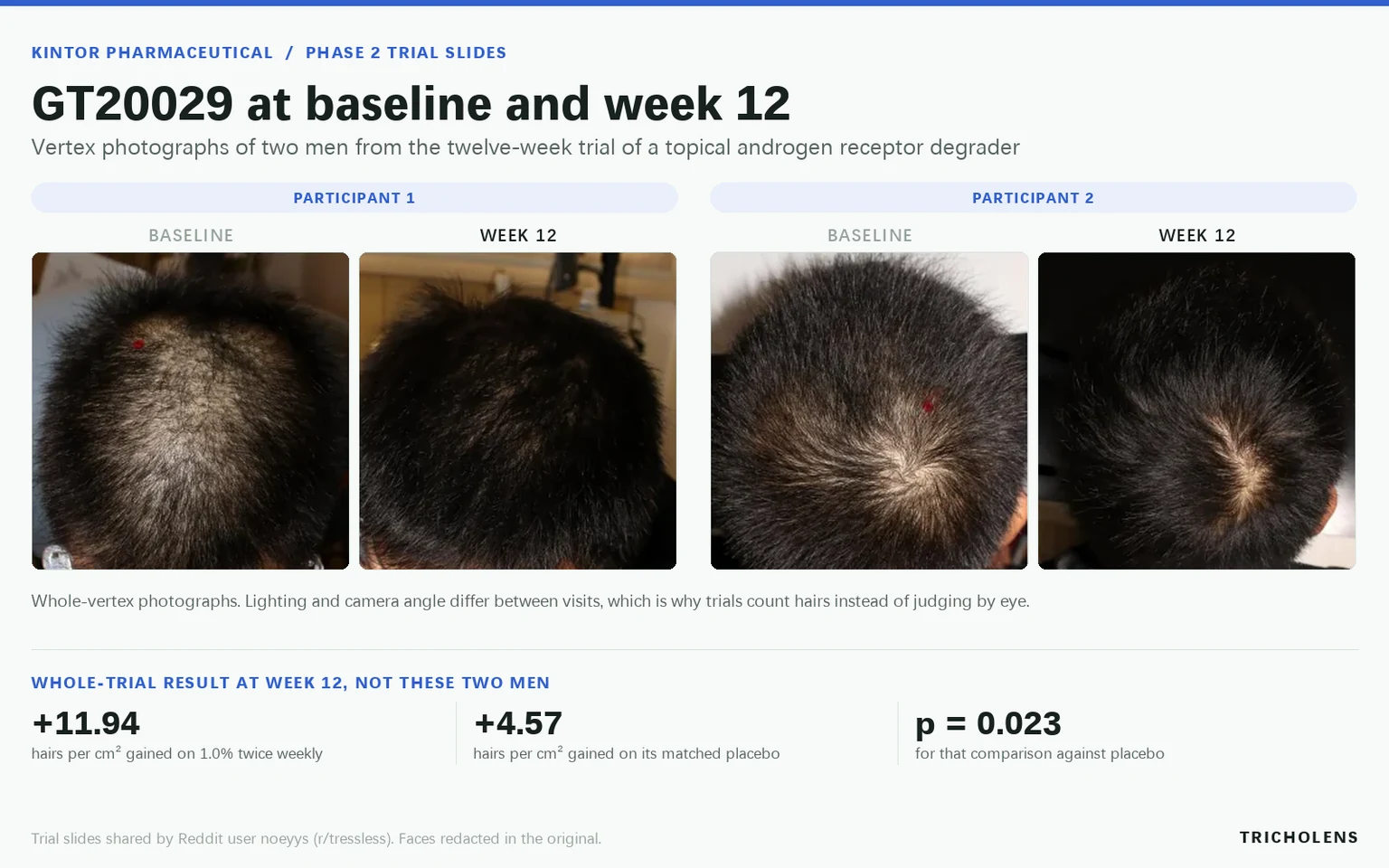
The images circulating from this program came out of a company presentation and were shared publicly by a Reddit user, noeyys, who interviewed Kintor scientists about both GT20029 and pyrilutamide. They are worth looking at, and they are worth looking at carefully.4546
Look at the four photographs below. The first man shows the kind of change that is hard to explain away. The second is more instructive, because his week 12 photograph is noticeably darker and shot from a different angle than his baseline one. Underexposure makes hair look denser. It fills in the shadow between strands and hides scalp. That is not an accusation of anything. It is simply what happens when two photographs of the same head are taken months apart without a fixed lighting rig, and it is why a person eyeballing a before-and-after is a poor instrument.
This is exactly why the trial did not use photographs like these as its measurement. The endpoint was a software count inside a tattoo-anchored square centimeter at twenty times magnification, not a human judgement of a picture. Presentation photographs are for communicating a result. The count is the result.1
Open full size The magnified view is more informative than the wide shot
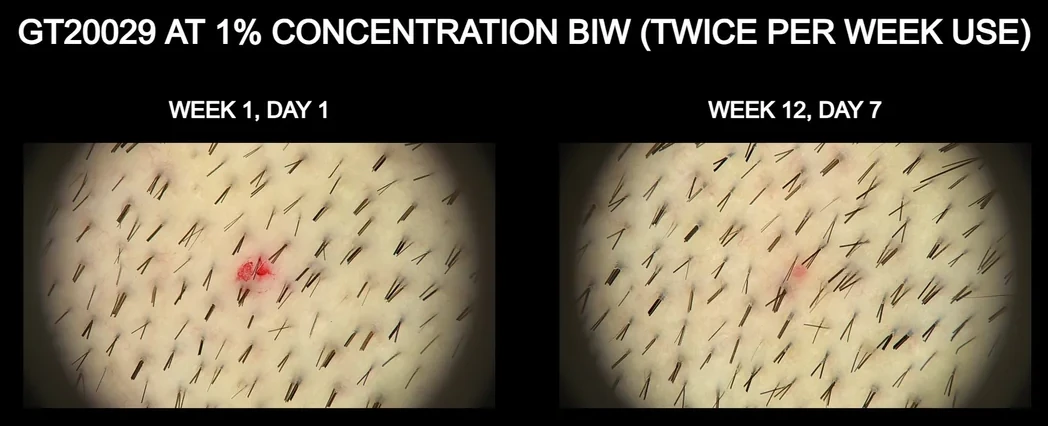
The second image is the more useful one, because it is close to what the trial actually measured. It shows a magnified patch of scalp on the 1.0% twice weekly schedule at the start and again at week 12. The pink ink reference dot is visible in both frames, which tells you the camera is looking at the same place.
What you look for in an image like this is not simply more hairs. It is more hairs emerging from the same follicular opening, and existing hairs looking thicker and darker. Healthy scalp normally grows hairs in small clusters of two or three from a shared opening. In androgenetic alopecia those clusters thin toward single hairs, and the ratio of thick hairs to fine ones drops. Below about four to one that ratio is considered abnormal, and below three to one it is considered diagnostic.42
A treatment that is working tends to reverse that, and it usually shows up as thickening before it shows up as counting. Which is exactly what the numbers did. The single cleanest statistical result in the whole trial was the hair width result on the 1.0% twice weekly arm, not the hair count result.1
 Open full size
 What went wrong, and how often
Across all 179 men in the safety analysis, 91 of them, or 50.8%, reported at least one adverse event of any kind. That sounds alarming until you see how it splits: 49.2% among the men on GT20029 and 54.1% among the men on placebo. When the placebo group reports slightly more problems than the drug group, most of what you are counting is ordinary life happening to 180 people over three months.1
Events the investigators judged to be actually caused by the study drug were less common: 14.4% on GT20029 against 8.2% on placebo. The main one was itching where the solution was applied, at 8.5% on the drug against 4.9% on placebo. Two men developed dermatitis at the application site, both in the same arm, and none on placebo. Every drug-related event was mild or moderate. Not one reached grade 3 or higher.1
There was exactly one serious adverse event in the whole trial, a blood vessel problem in the optic disc, and it occurred in a man on the twice weekly placebo. Investigators judged it unrelated to the study. Two men stopped treatment because of side effects, and both of them were on placebo as well. Not a single man in any GT20029 arm withdrew from the study. There were no deaths, no dose reductions, and no treatment-related serious events of any kind.1
On hormones, average testosterone stayed within the normal range in every group. Two men recorded a mild drop, both of whom were obese and had already been sitting near the bottom of the normal range at screening. The authors also note that testosterone swings considerably over the course of a day, so the time a sample is drawn moves the number. Neither man needed a dose change, and no sexual adverse events were reported.1
Combine that with the near-undetectable blood levels from both phase 1 studies and you have a reassuring twelve-week tolerability picture. It is the strongest thing this program has going for it, and it is the part of the story that most justifies further investigation. But keep the scale in view. This is 118 men exposed to the drug for three months. It is not a basis for statements about long-term safety, about fertility, or about what years of continuous use would do. Those questions need bigger trials that run longer.138
Four things about the paper itself that should give you pause
The trial design is sound and the primary results table is internally consistent. The paper wrapped around it is less careful, and the problems are the kind a reader should know about.
First, the discussion section overstates the trial’s own findings. It claims that all four doses of GT20029 produced statistically significant improvements from baseline in both hair count and hair width, and also produced significantly greater increases than placebo. The second half of that sentence is contradicted by the paper’s own results table, where two of the four arms plainly did not beat placebo. That sentence should never be quoted as a finding.1
Second, the group sizes do not match across the three tables. The 1.0% twice weekly arm appears as 31 men in the baseline table, 29 in the efficacy table, and 30 in the safety table. The three tables total 180, 176, and 179 men. The paper never explains where the missing men went, and the efficacy table reports zero missing values at both baseline and week 12, which cannot be squared with a smaller denominator.1
Third, the abstract quotes a p-value of less than 0.001 for the within-group increases, while the results section reports the same finding at the much weaker threshold of less than 0.05. More importantly, that p-value describes each group improving against its own starting point, not against placebo. Both placebo arms improved too. A reader skimming the abstract could easily walk away believing the drug beat placebo at p < 0.001 in all four arms, which is not close to what happened.1
Fourth, the funding statement says there is no funding associated with the work, while the disclosure statement immediately below it confirms that three of the authors are employees of Kintor, the company that makes the drug, and that they carried out the statistical analysis and contributed to data interpretation. The disclosure itself is proper and complete. The funding statement sitting next to it is hard to reconcile with it.1
None of this makes the results wrong. Industry-sponsored trials are normal, employee authorship is normal, and disclosing it is exactly what should happen. It is a reason to trust the numbers in the tables more than the sentences in the abstract and discussion, which is good practice with any drug paper. A separate methodological commentary on this trial has already been published in the same journal, so the wider field noticed too.13
What we still do not know
The list of unanswered questions here is long, and being clear about it is more useful than another round of enthusiasm.
- What happens after twelve weeksThe trial stopped at three months with a 28-day untreated follow-up. Whether the gains grow, plateau, or fade over six or twelve months is entirely unknown.
- What happens when you stopNobody has published what a scalp does after a course of an androgen receptor degrader ends. Receptors are proteins and cells build new ones, so the effect almost certainly wears off. How fast is not established.
- Whether it works on the hairlineThe measured area was on the front edge of the balding region toward the crown. Frontal hairline recession is a harder problem for every drug in this category, and this trial does not address it. Even finasteride’s label says its effect on recession at the temples was not established.
- Whether it works outside this populationNearly every participant was a Han Chinese man of about 32 with early to moderate loss. Baseline hair density and shaft characteristics vary considerably across populations, and response may vary with them.
- Whether it combines with anythingMen on minoxidil or finasteride were excluded. How a degrader behaves alongside the drugs most men are already taking is an open and fairly important question.
- Whether it causes early sheddingMany hair treatments trigger a temporary increase in shedding as follicles resynchronize. The paper does not report on this at all.
- Which dose and schedule is rightThe trial produced a coherent dose response on one schedule and an incoherent one on the other. Sorting that out is the entire job of the next study. Kintor has said it selected 1.0% twice weekly as the dose to carry forward.
- When it might arrive, if everA phase 3 trial was being designed at the time of publication, and as of August 2026 no phase 3 in hair loss appears to have started. Even in the best case, a drug at that stage is years from a pharmacy shelf, and further still in markets that require their own trials.
The idea is genuinely new. The evidence is genuinely early.
Two things are true at once here, and it is worth holding both.
The first is that GT20029 represents a real conceptual step. For thirty years, treating male pattern hair loss has meant choosing between lowering the hormone and covering the receptor. Removing the receptor is a third option that did not exist as a practical technology until recently, and the logic is sound. A molecule that destroys its target and then goes off to destroy another one is not doing the same job as a molecule that has to sit in place, and that difference is why a twice-weekly topical is even a plausible proposition. The FDA approval of the first protein degrader in May 2026 confirms the underlying technology can carry a drug all the way through.34
The second is that the evidence supporting this particular molecule is one twelve-week trial of 180 men in one country, in which two of four active arms beat their matched placebo and two did not, with wide confidence intervals, a dose response that appeared on one schedule and reversed on the other, a placebo arm that swung by twelve hairs in six weeks, and a discussion section that describes results the tables do not support. The tolerability signal over three months is good and the systemic exposure data are genuinely encouraging. The efficacy signal is a lead worth following, not a finding to bank on.1
If you are tracking this field, the number to watch is not 11.94. It is whatever comes out of a longer, larger trial with a hypothesis stated in advance and a six or twelve month endpoint. That is the study that will tell you whether protein degradation belongs in the hair-loss toolkit alongside the enzyme blockers and the receptor blockers, or whether it becomes another good idea that did not survive contact with a bigger sample. Kintor’s own history with pyrilutamide, where a 740-man phase 3 failed before a higher dose succeeded in a second one, is a fair warning about how often promising early numbers fail to repeat.2728
In the meantime, the most durable takeaway is not about GT20029 at all. It is the framework. Cut the supply, block the receptor, or destroy the receptor. Once you can place any new hair-loss compound into one of those three boxes, and then ask what its trial measured, for how long, and against what comparison, most of the noise around it becomes much easier to see through.
Sources & further reading
We prioritize official labels, professional medical organizations, and peer-reviewed literature. Sources accessed for this guide on .
- 1Efficacy and safety of topical GT20029 in male patients with androgenetic alopecia: a multicenter, randomized, double-blind, placebo-controlled phase 2 study
Journal of Dermatological Treatment, 2025;36(1):2574304
- 2
- 3Methodologic considerations in evaluating early clinical outcomes of GT20029 for androgenetic alopecia
Journal of Dermatological Treatment, 2026;37(1), via PubMed
- 4Male Androgenetic Alopecia
Endotext, National Center for Biotechnology Information
- 5Androgen Physiology, Pharmacology, Use and Misuse
Endotext, National Center for Biotechnology Information
- 6Biochemistry, Dihydrotestosterone
StatPearls, National Center for Biotechnology Information
- 7PROPECIA (finasteride) tablets: US prescribing information
DailyMed, U.S. National Library of Medicine
- 8AVODART (dutasteride) capsules: US prescribing information
DailyMed, U.S. National Library of Medicine
- 9The effects of finasteride on scalp skin and serum androgen levels in men with androgenetic alopecia
Journal of the American Academy of Dermatology, 1999, via PubMed
- 10Immunohistochemical localization of types 1 and 2 5-alpha-reductase in human scalp
British Journal of Dermatology, 1999, via PubMed
- 11Steroid 5-alpha-reductase deficiency in man: an inherited form of male pseudohermaphroditism
Science, 1974;186(4170):1213
- 12FDA alerts health care providers, compounders and consumers of potential risks associated with compounded topical finasteride products
U.S. Food and Drug Administration, 22 April 2025
- 13Efficacy and safety of topical finasteride spray solution for male androgenetic alopecia: a phase III, randomized, controlled clinical trial
Journal of the European Academy of Dermatology and Venereology, 2022, via PubMed
- 14The hair follicle: a paradoxical androgen target organ
Hormone Research, 2000, via PubMed
- 15Androgen actions on the human hair follicle: perspectives
Experimental Dermatology, 2013;22(3):168-171
- 16The androgen receptor amino-terminal domain: structure, function and therapeutic potential
Endocrine Oncology, 2025
- 17
- 18Structural basis for the nuclear import of the human androgen receptor
Journal of Cell Science
- 19Pharmacology of cyproterone acetate
Wikipedia
- 20Spironolactone
StatPearls, National Center for Biotechnology Information
- 21The importance of antiandrogen in prostate cancer treatment
Annals of Translational Medicine
- 22WINLEVI (clascoterone) cream: US prescribing information
DailyMed, U.S. National Library of Medicine
- 23
- 24Cosmo announces phase III topline results for Breezula
Cosmo Pharmaceuticals
- 25RU-58841 substance record and development status
NCATS Inxight Drugs
- 26
- 27Kintor announces results of the phase III clinical trial of KX-826 for men with androgenetic alopecia, 27 November 2023
MarketScreener, reporting Kintor Pharmaceutical
- 28
- 29
- 30
- 31PROTAC targeted protein degraders: the past is prologue
Nature Reviews Drug Discovery, 2022;21(3):181-200
- 32Affinity and cooperativity modulate ternary complex formation to drive targeted protein degradation
Nature Communications, 2023
- 33The Nobel Prize in Chemistry 2004: ubiquitin-mediated protein degradation
The Nobel Foundation
- 34Arvinas announces FDA approval of VEPPANU (vepdegestrant), the first approved PROTAC degrader
Arvinas Investor Relations
- 35Company profile and pipeline
Kintor Pharmaceutical Limited
- 36Kintor announces positive topline US phase I trial results of GT20029
Kintor Pharmaceutical
- 37NCT05428449: safety, tolerability and pharmacokinetics of GT20029
ClinicalTrials.gov
- 38EADV 2023 abstract 750: safety, tolerability and pharmacokinetics of GT20029 gel and solution in healthy subjects
European Academy of Dermatology and Venereology
- 39Finasteride in the treatment of men with androgenetic alopecia
Journal of the American Academy of Dermatology, 1998, via PubMed
- 40A randomized clinical trial of 5% topical minoxidil versus 2% topical minoxidil and placebo in the treatment of androgenetic alopecia in men
Journal of the American Academy of Dermatology, 2002, via PubMed
- 41
- 42Trichoscopy of androgenetic alopecia: a systematic review
Journal of Clinical Medicine, 2024, via PubMed Central
- 43
- 44The ASA statement on p-values: context, process, and purpose
The American Statistician, 2016
- 45I interviewed Kintor: GT20029 clinical trial pictures, as well as KX826
Reddit, r/tressless, posted by noeyys
- 46


Comments and replies
The discussion about What GT20029 actually is, and what its phase 2 trial really showed is public. Everyone can read every thread and reply. Signed-in members can comment, reply, and mention people with their @handle.