HopeMed Accuses Absci of Misusing HMI-115 Data: Inside the ABS-201 Fight
Hope Medicine says Absci used its macaque-study assets without permission and built a misleading comparison around data that were never made public. The decks exist. So do the gaps. Here is the cleanest way to read the dispute without choosing a winner before the human evidence arrives.
Uses the best matching voice on your device. No subscription or per-listen fee.
 Open full size
 Key takeaways
- Hope Medicine alleges that Absci used HMI-115 macaque-study data and images without authorization and made misleading pharmacokinetic and receptor-occupancy comparisons. That is a company accusation and legal demand, not a court finding.
- The challenged comparison is real: Absci placed HMI-115 and ABS-201 PK/RO curves in SEC-filed investor decks. Those slides describe preliminary modeling, not a human head-to-head trial.
- Hope says the AGA Phase Ib and Phase II PK/RO data behind HMI-115 were never publicly disclosed. That makes Absci's modeled HMI-115 occupancy estimates the central evidentiary question, not an established clinical fact.
- HMI-115 has a small, company-reported Phase Ib hair-count signal and a completed 192-man randomized Phase II with no posted results. ABS-201 has interim safety and PK data in 32 healthy adults, but no human hair-growth result yet.
- Rodney Sinclair has documented roles in both programs. Andreas Busch moved from Bayer to Absci. Those overlaps explain why people are asking questions, but the public record does not show that either man transferred confidential information.
- Lilly invested in Absci and also participated in Amplifica's financing. That shows serious pharmaceutical interest in hair biology, not proof that any one experimental treatment works.
HopeMed did not whisper this one
On August 25, Hope Medicine published the kind of corporate notice that is difficult to misread. It accused Absci of using data and images from a stump-tailed-macaque hair-growth study without authorization, challenged Absci's comparison of HMI-115 with ABS-201, said outside counsel had been engaged, and demanded that the relevant material be withdrawn and destroyed.1
The language is aggressive. The legal status is more limited. Hope said it was conducting a legal assessment and reserving its rights; the notice does not announce a filed lawsuit or a judgment. Throughout this article, "Hope alleges" is doing real work.1
There are really two disputes packed into the release. One is about ownership and permission: who may reproduce the macaque data and the particular chart images. The other is scientific: whether Absci had a defensible basis for estimating HMI-115 pharmacokinetics and receptor occupancy, then using those estimates to suggest that ABS-201 had been designed around HMI-115's shortcomings.15
The comparison HopeMed objects to is sitting in public SEC exhibits
Absci did not make one stray comparison in a podcast and move on. SEC-hosted investor presentations from August and November 2025 and March and May 2026 show the macaque hair-growth sequence, a comparative nonhuman-primate PK chart, and modeled receptor-occupancy curves for HMI-115 and ABS-201. The November deck explicitly calls the analysis "preliminary in silico modeling" and lists assumptions for skin exposure and receptor concentration.2345
The March presentation says the model used published nonhuman-primate and Phase Ib HMI-115 PK data plus Absci's in-house data. Hope's answer is blunt: neither it nor Bayer publicly disclosed AGA Phase Ib or Phase II PK/RO results, and the comparison did not come from an authorized Hope or Bayer dataset. That conflict is the heart of the story.41
The old macaque experiment was described in a public patent application. That fact matters, but it does not automatically settle ownership of every underlying image, permission to reproduce a chart, or the validity of a later human PK/RO model. Publicly viewable and free of rights or context are not synonyms.61
Two antibodies, four very different kinds of evidence
The fastest way to get lost in this argument is to place a measured trial result, a sponsor press release, a model output, and a legal allegation in the same column as though they carry equal weight. They do not. Use the filters below to see which claims are measured, sponsor-reported, modeled, or alleged.810151
Two PRLR antibodies, two incomplete records
Compare what has been measured, what each sponsor has reported, what remains a model, and what Hope Medicine has formally alleged.
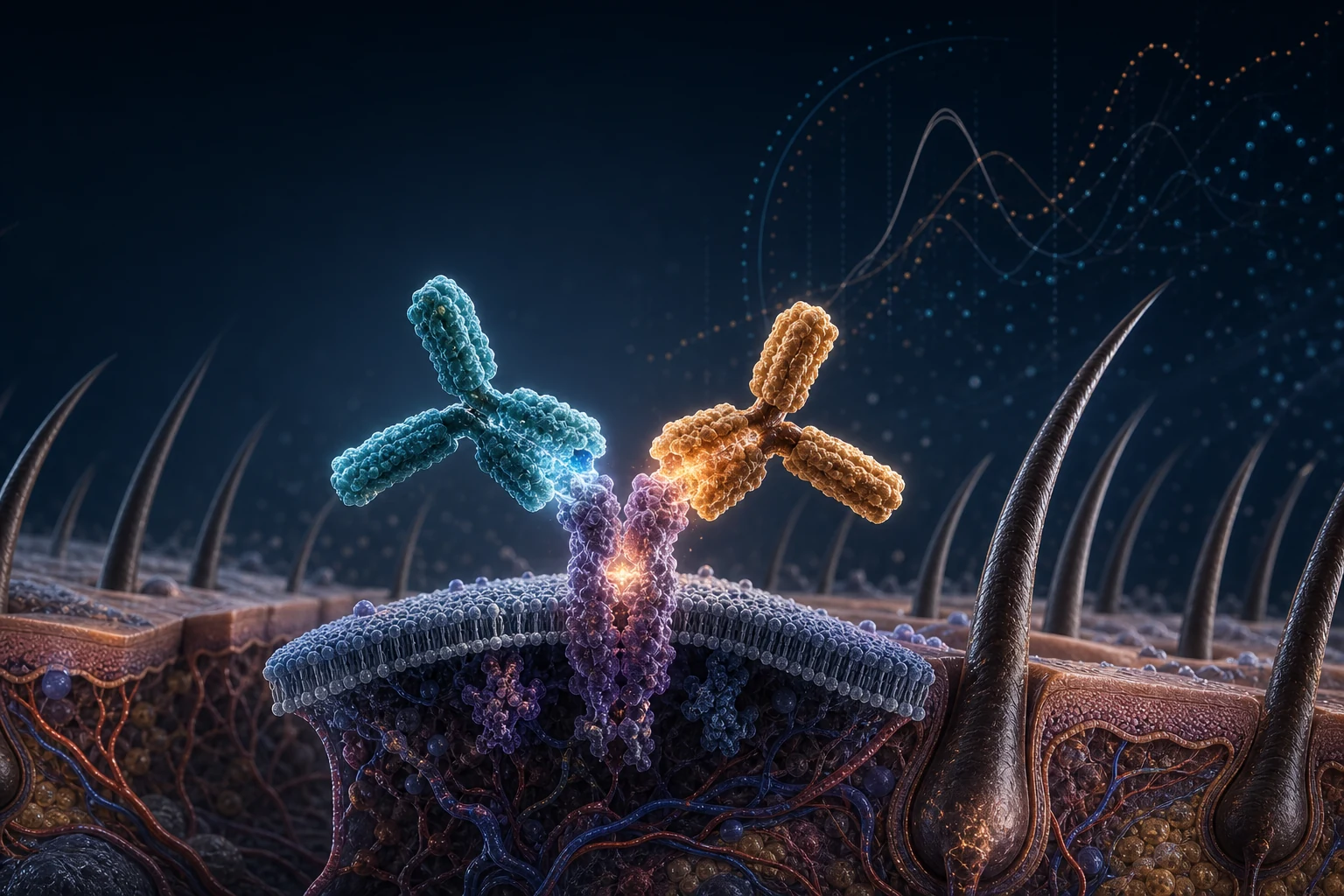
Both are intended to block the prolactin receptor
This animation illustrates the target only. It is not a dose-response curve, an occupancy estimate, or evidence that the antibodies perform alike.
Showing all: 8 of 8 comparison topics.
| Question | HMI-115Hope Medicine | ABS-201Absci |
|---|---|---|
| Identity / targetWhat is it? |
|
|
| Sponsor / originWho developed it? |
|
|
| Public human evidenceWhat has been observed in people? |
|
|
| AGA efficacyIs there public human hair-count evidence? |
|
|
| PharmacokineticsHow long does it remain in circulation? |
|
|
| Receptor occupancyHow much PRLR blockade is established? |
|
|
| Dosing statusWhat is known about frequency? |
|
|
| Macaque evidenceWhat do the primate materials show? |
|
|
What is it?
HMI-115 Hope Medicine
A monoclonal antibody against the prolactin receptor (PRLR).
Sponsor-reported
ABS-201 Absci
An IgG1 monoclonal antibody against PRLR.
Sponsor-reported
Who developed it?
HMI-115 Hope Medicine
Originated at Bayer and was licensed to Hope Medicine for global development and commercialization.
Sponsor-reported
ABS-201 Absci
Designed and developed by Absci.
Sponsor-reported
What has been observed in people?
HMI-115 Hope Medicine
Hope has reported a Phase Ib AGA result in 12 men.
MeasuredSponsor-reportedA randomized Phase II study in 192 men is completed, but results have not been publicly posted.
MeasuredSponsor-reported
ABS-201 Absci
Interim single-ascending-dose data cover 32 healthy adults; the Phase 1/2 program is ongoing.
MeasuredSponsor-reported
Is there public human hair-count evidence?
HMI-115 Hope Medicine
Hope reported a mean increase of 14 non-vellus hairs/cm² in the 12-man Phase Ib study.
MeasuredSponsor-reportedThe larger Phase II efficacy result remains unknown publicly.
Sponsor-reported
ABS-201 Absci
No human hair-growth efficacy result has been reported.
Sponsor-reported
How long does it remain in circulation?
HMI-115 Hope Medicine
Hope says AGA Phase Ib and Phase II PK data have not been publicly disclosed.
AllegedAbsci has published comparative PK analyses; Hope disputes the data basis for those comparisons.
ModeledAlleged
ABS-201 Absci
Absci reported an estimated half-life of at least 65 days in interim Phase I data.
MeasuredSponsor-reported
How much PRLR blockade is established?
HMI-115 Hope Medicine
Hope says human AGA receptor-occupancy data have not been publicly disclosed.
AllegedPublished HMI-115 occupancy curves attributed to clinical doses are disputed by Hope.
ModeledAlleged
ABS-201 Absci
More than 90% trough occupancy at proposed doses is an Absci model prediction, not a reported human measurement.
ModeledSponsor-reported
What is known about frequency?
HMI-115 Hope Medicine
Clinical dosing has been tested, but public AGA PK/occupancy data do not establish an optimal schedule.
MeasuredSponsor-reported
ABS-201 Absci
Sparse dosing is a development goal supported by interim PK and modeling; it is not yet a proven AGA regimen.
MeasuredModeledSponsor-reported
What do the primate materials show?
HMI-115 Hope Medicine
Stump-tailed macaque hair-growth images and data form part of HMI-115’s published scientific rationale.
MeasuredSponsor-reportedHope alleges that Absci reused Hope-controlled charts without authorization.
Alleged
ABS-201 Absci
Absci has cited its own non-human-primate PK work in model development.
MeasuredSponsor-reportedNo ABS-201 macaque hair-growth efficacy result has been publicly reported.
Sponsor-reported
PK and receptor occupancy sound interchangeable. They are not.
Pharmacokinetics, or PK, describes what the body does to a drug: how exposure rises after a dose, how it distributes, and how quickly it declines. Receptor occupancy, or RO, estimates how much of the intended target is bound at a given exposure. Half-life can help a dose last longer, but a long half-life does not by itself prove that enough antibody reaches scalp tissue, binds the right receptor population, or grows hair.
Absci's public thesis is that sustained, high PRLR occupancy is necessary and that HMI-115 did not maintain it at the tested doses. Its decks and CEO interview place HMI-115 around 65% to 70% in the model and frame greater than 90% occupancy as the design target for ABS-201. Hope disputes the public foundation for that HMI-115 estimate. There is no disclosed human head-to-head RO experiment that resolves the disagreement.34181
This is also why the popular claim that HMI-115 was simply "underdosed tenfold" is too neat. A milligram-per-kilogram comparison between monkeys and humans cannot substitute for species scaling, affinity, tissue exposure, dose interval, target abundance, and measured occupancy. Absci may ultimately be right that exposure limited HMI-115. The public data do not yet let readers audit that conclusion.51
HopeMed has the more mature AGA program and the less complete public dataset
HMI-115 began at Bayer and was licensed to Hope Medicine in 2019. In January 2024, Hope reported results from an open-label Phase Ib study of 16 people. Among the 12 men, the company reported an average increase of 14 non-vellus hairs per square centimeter after 24 weeks. The release described the treatment as safe and well tolerated.789
That is an encouraging company-reported signal, not a definitive efficacy result. The small study had no control arm, and the release did not provide the full adverse-event table, confidence intervals, or the AGA PK/RO dataset now at issue.89
The next study was much larger: a randomized Phase II in 192 men, with placebo and 120 mg or 240 mg dosing schedules. ClinicalTrials.gov lists the study as completed in November 2024. As of this review, no results are posted, and Hope's public pipeline still places AGA in Phase II. Silence is not proof that the drug failed, but after a completed study of that size it is a fair reason for impatience.1011
| Question | Public record | Limit |
|---|---|---|
| Human hair signal | +14 non-vellus hairs/cm² in 12 men, company-reported Phase Ib | Small, open-label study; no control arm |
| Phase II | 192 men; randomized; listed as completed | No results posted |
| AGA PK / RO | Hope says it has not publicly disclosed Phase Ib or II data | Absci's comparison is modeled and disputed |
| Development status | Hope pipeline shows Phase II | No authoritative 2027 launch or AGA Phase III record found |
Absci has an interesting PK result, not a human hair-growth result
ABS-201 is a different anti-PRLR antibody, designed by Absci and listed in the trial registry as an IgG1. The ongoing Phase 1/2 HEADLINE study began with single ascending doses in healthy adults before moving into repeated dosing in people with androgenetic alopecia.1314
In June 2026, Absci released blinded aggregate data from 32 healthy adults. It reported no serious adverse events, mostly mild treatment-emergent events, and an estimated half-life of at least 65 days. One moderate headache was assessed as unlikely related; the treatment-related events the company reported were mild.15
Those findings are useful. They support continued study and make infrequent dosing plausible. They do not show that ABS-201 grows hair, reverses gray hair, wakes long-dormant follicles, or produces years of benefit. The AGA efficacy cohort had only just begun when the interim release appeared. Greater-than-90% occupancy and two or three injections over six months remain model-guided development claims until the clinical measurements catch up.15134
The CEO interview is unusually useful, as long as its claims keep their labels
In a long-form interview with Joe Tillman, Absci founder and CEO Sean McClain lays out the company's argument in plain English. The embedded video starts near 21:50, where he says HMI-115 was underdosed, describes the 65% to 70% occupancy estimate, and contrasts it with Absci's greater-than-90% target. That is the exact comparison Hope later challenged.181
Elsewhere in the interview, McClain discusses possible two- or three-dose treatment courses, pigmentation, durable macaque regrowth, and recovery of dormant follicles. He is candid at several points that the strongest human outcomes are not known yet. Those ideas are a development hypothesis and a reason to run the trial, not a preview of a result that has already happened.1813
Rodney Sinclair connects the programs. That fact is not evidence of a leak.
Rodney Sinclair led HMI-115's Phase Ib AGA study and served on Hope's Phase II steering committee. In August 2025, Absci added him to the ABS-201 scientific advisory board; he later became principal investigator for HEADLINE. McClain confirms the overlap in the interview.128161418
There is a second bridge. Andreas Busch, Absci's chief innovation officer, previously led drug discovery at Bayer. Absci's May 2026 deck says Busch commissioned the macaque study while at Bayer, while Hope's notice emphasizes that its founder Xiao Ruiping led the work with Bayer and a Hope Medicine–Peking University laboratory.1751
That is an unusually tight concentration of scientific history, and it explains why the online speculation took off. It does not prove that Sinclair, Busch, or anyone else handed confidential data to Absci. Hope's announcement names Absci, not either individual, and the public sources reviewed for this article do not establish a transfer of trade secrets or misconduct.11617
Lilly is interested in the category, not handing out efficacy trophies
Eli Lilly put $40 million into Absci as part of a $100 million 2026 offering. Absci said the investment did not give Lilly rights to the program, although a Lilly representative joined its endometriosis advisory board. The financing helps Absci run the work. It does not validate the disputed HMI-115 model or prove ABS-201 efficacy.1920
Lilly also participated in Amplifica's $26 million Series B, with no individual check size disclosed. That makes the more interesting pattern portfolio-wide: a large pharmaceutical company now has financial exposure to multiple experimental hair-growth approaches. Our Amplifica and PP405 evidence review looks at that other investment in detail.21
Capital is a vote for the opportunity to generate data. It is not the data. Lilly backing more than one company is better read as category interest and risk spreading than as a secret ranking of which hair program will win.1921
What would actually settle the argument
The public conversation is trying to extract a winner from two incomplete packages. Hope has more AGA clinical exposure but has not posted its completed Phase II results. Absci has a transparent design story and an encouraging early PK estimate but no human hair-growth result. There is no head-to-head trial.101513
A definitive answer does not require another investor slide. It requires enough primary data to let outside readers reproduce the logic and enough clinical data to show that the logic matters to a scalp.
- HopeMed's complete Phase II AGA resultsHair counts, dose response, all randomized groups, uncertainty ranges, adverse events, discontinuations, and enough PK/RO context to understand the exposure-response relationship.
- Absci's model provenanceThe exact public inputs, transformations, assumptions, uncertainty, and validation behind its HMI-115 curves—without relying on material Hope says was never disclosed or authorized.
- ABS-201 repeated-dose and AGA efficacy dataMeasured exposure and occupancy alongside target-area hair count, hair width, pigmentation, safety, dose response, and follow-up long enough to test the durability story.
- A clear response to the rights disputeAbsci can explain its permission and provenance for the macaque assets, or replace the disputed material. Hope can identify precisely which assets and uses it says cross the line.
Sources & further reading
We prioritize official labels, professional medical organizations, and peer-reviewed literature. Accessed for this guide on .
- 1Hope Medicine Inc. Announcement Regarding ABSCI CORPORATION Materials
Hope Medicine Inc.
- 2Absci Corporate Presentation, August 12, 2025
U.S. Securities and Exchange Commission
- 3Absci Corporate Presentation, November 12, 2025
U.S. Securities and Exchange Commission
- 4Absci Corporate Presentation, March 24, 2026
U.S. Securities and Exchange Commission
- 5Absci Corporate Presentation, May 7, 2026
U.S. Securities and Exchange Commission
- 6WO2019011719A1: Use of Prolactin Receptor Antibody for Treatment of Alopecia
WIPO record via Google Patents
- 7Hope Medicine Announces Global License Agreement With Bayer for BAY1158061 / HMI-115
Hope Medicine via PR Newswire
- 8Positive Phase Ib Results of HMI-115 in Androgenic Alopecia
Hope Medicine Inc.
- 9
- 10
- 11Hope Medicine Product Pipeline
Hope Medicine Inc.
- 12Hope Medicine Research Platform and HMI-115 AGA Program
Hope Medicine Inc.
- 13NCT07317544: HEADLINE Phase 1/2 Study of ABS-201
ClinicalTrials.gov
- 14
- 15Absci Announces Interim Phase 1 Data From the HEADLINE Trial
Absci Corporation
- 16Absci Adds Rodney Sinclair to the ABS-201 Scientific Advisory Board
Absci Corporation
- 17Absci Appoints Andreas Busch as Chief Innovation Officer
Absci Corporation
- 18ABS-201: This New Molecule Could Finally Stop Your Hair Loss
The Hair Transplant Channel, interview with Absci CEO Sean McClain
- 19Absci Announces Pricing of $100 Million Underwritten Offering
Absci filing via U.S. Securities and Exchange Commission
- 20
- 21Amplifica Completes $26 Million Series B Financing to Advance Injectable Pipeline for Hair Growth
Amplifica Holdings Group, Inc.
Comments and replies
The discussion about HopeMed Accuses Absci of Misusing HMI-115 Data: Inside the ABS-201 Fight is public. Everyone can read every thread and reply. Signed-in members can comment, reply, and mention people with their @handle.