Kintor Takes On Pelage: KT-215 Opens an East–West Race for the MPC Hair-Loss Pathway
One new row in Kintor’s pipeline puts a Chinese dermatology company directly into Pelage’s scientific lane. The target is exciting. The human evidence is uneven. And the commercial route may be almost as interesting as the molecule.
Uses the best matching voice on your device. No subscription or per-listen fee.
 Open full size
 Key takeaways
- Kintor’s August 2026 filing identifies KT-215 as a topical mitochondrial pyruvate carrier inhibitor for androgenetic alopecia in China. A preclinical candidate has been selected, but no structure, dose, patent mapping, human trial, or result has been disclosed.
- KT-215 enters the same target class as Pelage’s PP405, but no public evidence shows that the compounds are chemically related, licensed from the same inventors, or compared head to head.
- The pathway began with UCLA mouse research linking lactate production and MPC1 inhibition to hair-follicle stem-cell activation. Pelage is the clinical leader; Kintor is a newly disclosed preclinical challenger.
- A 2024 ex-vivo human-follicle study found that high-dose UK-5099 could arrest proliferation and activate the integrated stress response. That is a real development question, not proof that PP405 or KT-215 causes long-term follicle damage.
- Bald AGA scalp can retain epithelial stem cells while losing important progenitor populations, but that does not reduce the disease to one broken cell type. Epithelial stem cells and the mesenchymal dermal-papilla niche have to be evaluated together.
- Kintor has not announced a cosmetic route for KT-215. Its existing drug-and-cosmetics playbook makes that route conceivable, while Stemoxydine offers an adjacent precedent—not a regulatory shortcut or evidence that KT-215 works.
Kintor just walked into Pelage’s lane
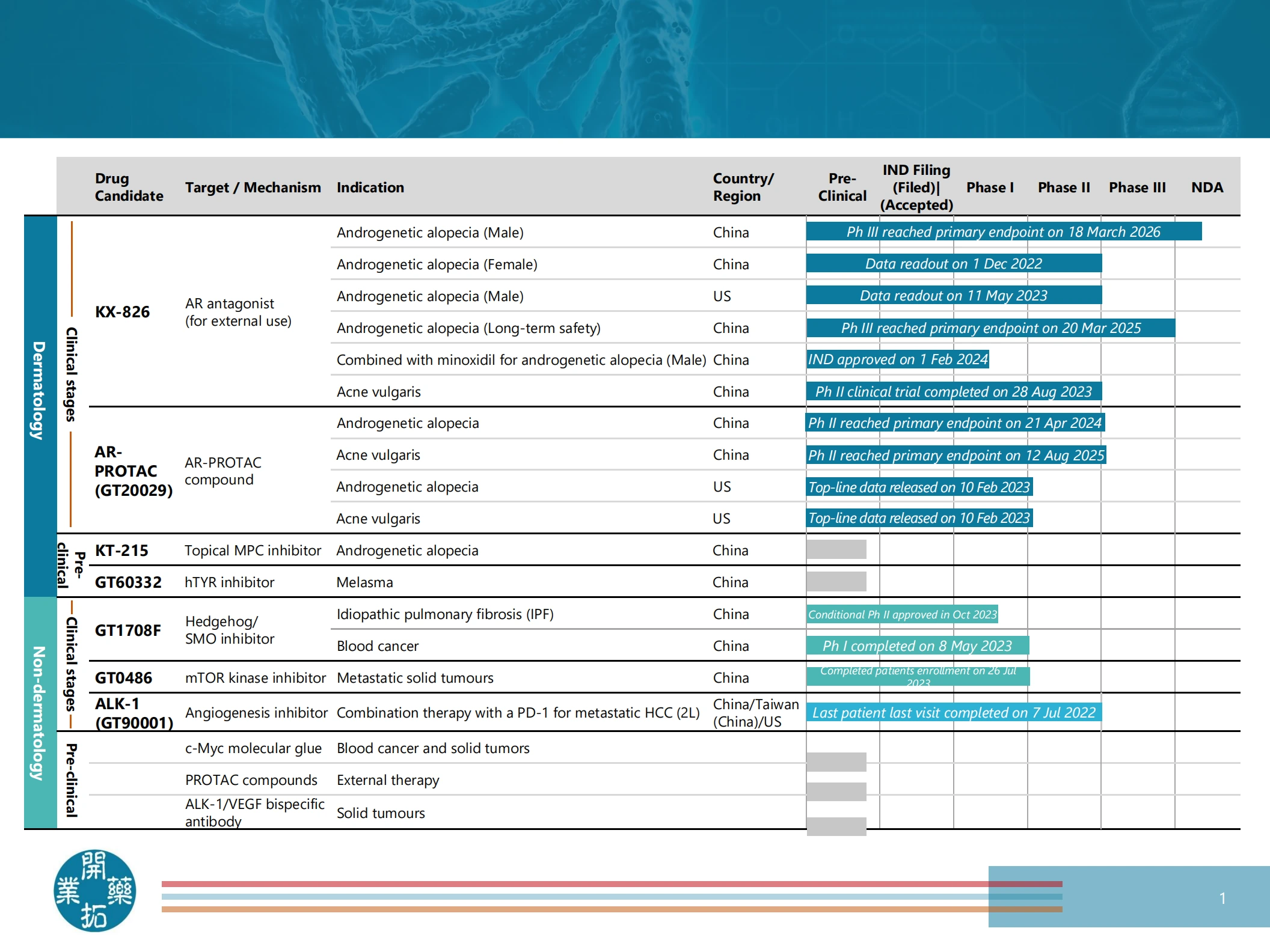
On August 19, 2026, Kintor Pharmaceutical added a quiet but consequential program to its public story: KT-215, a topical mitochondrial pyruvate carrier inhibitor for androgenetic alopecia. The company’s interim filing places it in China and at the preclinical stage. Kintor says it has selected a preclinical candidate compound and that preclinical work is underway.1
That is the publicly disclosed package we could verify under the KT-215 name. Kintor has not published the chemical structure, concentration, formulation, potency, selectivity, animal result, toxicology package, patent family, clinical timetable, or a single human datapoint. A box on a pipeline is not a medicine. It is still meaningful because the box names one of the most closely watched new targets in hair biology.12
The competitive framing is hard to miss. Pelage Pharmaceuticals built its identity around PP405, a topical MPC-pathway drug born from UCLA research, and took it through a randomized Phase 2a study. Kintor has now declared a program aimed at the same carrier and the same condition. There is no announced contest between the companies and no head-to-head experiment. Commercially, though, an East–West race has begun.101
 Open full size
 The road to KT-215 runs through a UCLA metabolism experiment
The origin story starts in 2017, before PP405 was a familiar code. A UCLA-led team including Aimee Flores, Heather Christofk, and William Lowry reported that mouse hair-follicle stem cells were unusually glycolytic and produced substantial lactate. Removing Ldha, the enzyme that converts pyruvate to lactate, delayed stem-cell activation. Removing Mpc1 pushed metabolism in the opposite direction and accelerated stem-cell activation and the hair cycle.5
The same paper used small molecules to increase lactate production and topically induce the mouse hair cycle. That was the conceptual leap: instead of treating a follicle only as a hormone target, treat its metabolic state as a switch. Pelage says it licensed the program in 2018; UCLA publicly announced the exclusive license in May 2019. The company was founded by Lowry, Christofk, and medicinal chemist Michael Jung.5610
Medicinal chemistry followed. A 2021 Journal of Medicinal Chemistry paper described a large UK-5099 analogue family and measured JXL069 in a cellular respiration assay. It also reported more than ten MPC-inhibitory compounds that accelerated hair cycling in mice, but JXL069 was not one of the compounds shown in the mouse-growth figure. A separate 2021 study found that blocking pyruvate transport could accelerate hair cycling in several mouse models of refractory growth, including age, stress, and repeated chemotherapy models.78
Pelage turned that academic program into PP405 and a controlled human-development plan. Its completed Phase 2a randomized study enrolled 78 adults, used four weeks of once-daily topical treatment, and followed participants to 12 weeks. Pelage reported that the study met its safety endpoint and announced an exploratory hair-density signal in a higher-loss male subgroup. The public registry result record reports safety and pharmacokinetics, but not the complete hair-growth analysis.910
- 012017 · the metabolic switch
UCLA mouse work links LDH-dependent lactate production and MPC1 loss to faster hair-follicle stem-cell activation.
- 022018–2019 · the company
Pelage dates its license to 2018; UCLA publicly announces the exclusive license in May 2019.
- 032021 · medicinal chemistry
UCLA collaborators publish a family of topical MPC inhibitors and mouse hair-growth experiments.
- 042024–2026 · clinical validation begins
Pelage completes its 78-person PP405 Phase 2a and announces plans for late-stage studies.
- 05August 2026 · a new challenger
Kintor discloses KT-215 and says a preclinical candidate has been selected.
Close one mitochondrial gate, redirect the fuel
Glycolysis breaks glucose down into pyruvate in the cell’s cytoplasm. Under ordinary conditions, the mitochondrial pyruvate carrier moves some of that pyruvate across the inner mitochondrial membrane, where it can become acetyl-CoA and feed the tricarboxylic-acid cycle. The carrier is therefore a gate between cytosolic glycolysis and mitochondrial oxidation.11
Block that gate and more pyruvate remains outside the mitochondrion. Lactate dehydrogenase can convert it into lactate. In the foundational mouse work, that lactate-linked metabolic state was associated with activation of quiescent epithelial hair-follicle stem cells. Kintor describes KT-215 using essentially this rationale: inhibit MPC, increase LDH activity, activate follicle stem cells, and promote growth.51
The final arrow is a hypothesis, not a law of nature. A metabolite can be fuel, waste, signal, or stress marker depending on dose, cell type, timing, hair-cycle stage, and tissue context. Mouse telogen skin, a cultured human anagen follicle, and a balding human scalp are not interchangeable systems.12
One metabolic target, three very different biological questions
Follow pyruvate through the proposed MPC hair-growth pathway, then compare the public record for KT-215, PP405 and the mechanistically distinct Stemoxydine precedent.
Conceptual map, not a dose-response model. Arrow strength and motion do not represent potency, exposure, efficacy or risk.
Showing Normal transport: Pyruvate can enter the mitochondrion through MPC. Animation playing.
Pyruvate can enter the mitochondrion through MPC
Glycolysis produces pyruvate in the cytosol. The mitochondrial pyruvate carrier moves some of it into mitochondria, where it can support oxidative metabolism.
- Glucose is converted to pyruvate outside the mitochondrion.
- MPC1 and MPC2 form the carrier complex represented here as one gate.
- Pyruvate has several possible fates; this diagram shows only the branches relevant to the hair-follicle hypothesis.
Shared language does not mean shared evidence
KT-215 and PP405 occupy the same development category. Stemoxydine reaches the stem-cell story through a different target and should not be described as an MPC inhibitor.
| Program | Pathway and route | Stage | What the public record supports |
|---|---|---|---|
| KT-215Kintor Pharmaceutical | Listed by Kintor as an MPC inhibitor for androgenetic alopecia. Topical program | Preclinical | Kintor discloses the program and target in its pipeline. No human KT-215 safety or efficacy data have been disclosed. Publicly disclosedPreclinical |
| PP405Pelage Pharmaceuticals | Developed as an MPC inhibitor intended to reactivate dormant hair-follicle stem cells. Topical clinical program | Completed Phase 2a | PP405 has been studied in people, but those results cannot be transferred to KT-215. No head-to-head trial exists. Publicly disclosed |
| StemoxydineL’Oréal-developed molecule | A prolyl-4-hydroxylase inhibitor associated with pseudohypoxic signaling. It is not an MPC inhibitor. Cosmetic ingredient precedent | Marketed cosmetic products | It is useful as a commercial analogy for a stem-cell-oriented cosmetic story, not as target equivalence or a regulatory shortcut for KT-215. Publicly disclosedHypothesis / open question |
KT-215
- Route
- Topical program
- Pathway
- Listed by Kintor as an MPC inhibitor for androgenetic alopecia.
- Public record
- Kintor discloses the program and target in its pipeline. No human KT-215 safety or efficacy data have been disclosed.
PP405
- Route
- Topical clinical program
- Pathway
- Developed as an MPC inhibitor intended to reactivate dormant hair-follicle stem cells.
- Public record
- PP405 has been studied in people, but those results cannot be transferred to KT-215. No head-to-head trial exists.
Stemoxydine
- Route
- Cosmetic ingredient precedent
- Pathway
- A prolyl-4-hydroxylase inhibitor associated with pseudohypoxic signaling. It is not an MPC inhibitor.
- Public record
- It is useful as a commercial analogy for a stem-cell-oriented cosmetic story, not as target equivalence or a regulatory shortcut for KT-215.
KT-215 and PP405 share a target class—not an evidence level
Calling KT-215 “Kintor’s PP405” is useful shorthand only if the limits are stated immediately. Both are described as topical MPC-pathway programs for hair loss. Pelage has years of chemistry, clinical manufacturing, and human testing behind its code. Kintor has disclosed a selected preclinical candidate and little else.110
Kintor may ultimately differentiate on potency, selectivity, scalp retention, dosing schedule, vehicle, patent position, cost, or regulatory geography. It may also discover that the human therapeutic window is narrow. Until the company identifies the molecule and publishes comparative experiments, there is no evidence that KT-215 is better, safer, weaker, or chemically similar to PP405.
| Question | KT-215 · Kintor | PP405 · Pelage |
|---|---|---|
| What is disclosed? | Topical MPC inhibitor; AGA; China; selected preclinical candidate | Topical small molecule aimed at follicle metabolism; controlled clinical gel |
| Development stage | Preclinical | Completed randomized Phase 2a; late-stage studies announced |
| Human exposure | None disclosed | 78-person Phase 2a plus earlier clinical work |
| Public hair signal | None | Sponsor-reported exploratory subgroup signal; complete hair-growth dataset not posted |
| Molecule identity | Not disclosed | PP405 remains a sponsor code; suvomipic/JXL069 is a plausible but unconfirmed identity theory |
| Biggest unknown | Almost everything beyond the target and route | Magnitude, durability, full efficacy dataset, repeat/chronic dosing, and long-term safety |
JXL069 is suvomipic. Suvomipic is not yet publicly proven to be PP405.
The molecule-name story became more concrete in 2026 when the World Health Organization’s proposed INN list defined suvomipic’s chemical structure. That structure matches JXL069 in the published UCLA chemistry paper. Our full suvomipic and PP405 evidence review found that the chemical record, UCLA origins, mechanism, patents, and timeline make suvomipic the strongest public candidate for PP405’s active substance.137
One link is established: JXL069 is suvomipic. The next link remains missing. The WHO document does not name Pelage or PP405, Pelage has not publicly adopted suvomipic as a synonym, and the trial registry still uses the PP405 code. A plausible identity is not the same thing as an authenticated clinical product.139
KT-215 adds no new piece to that identity puzzle. Kintor has not connected KT-215 to JXL069, suvomipic, UCLA, Pelage, or any published chemical series. Until a structure or patent appears, KT-215 should be treated as an undisclosed compound that targets the same carrier—not as another name for an existing molecule.1
What if the metabolic push becomes too much stress?
The most serious mechanistic criticism does not come from a message-board theory. It comes from a 2024 peer-reviewed experiment on living human scalp follicles maintained outside the body. Researchers exposed anagen follicles to the research MPC inhibitor UK-5099 at 10 or 40 micromolar for two days. At the higher exposure, proliferation fell in the bulge and hair matrix, mitochondrial markers changed, and key follicle signaling networks were disrupted.12
Transcriptomics showed activation of the integrated stress response, including an ATF4-linked signature. The ISR is an emergency program: it reduces general protein synthesis and can pause the cell cycle while a cell adapts. If adaptation fails, parts of the program can move toward apoptosis. In this experiment, ISRIB reduced ADM2 expression and partly restored Ki-67, but it did not normalize every stress readout or reverse the increase in cleaved-caspase-3-positive matrix cells.12
The authors wrote that sustained disruption of normal follicular proliferation could lead to dystrophic anagen or catagen. That deserves attention because a hair drug may need repeat or chronic use. It does not establish that PP405, KT-215, or every MPC inhibitor will cause anagen effluvium. UK-5099 is not either finished product; 40 micromolar for 48 hours was an aggressive ex-vivo condition; the follicles were already in human anagen; and medicinal chemistry plus topical pharmacokinetics can produce a different tissue exposure.127
The tension is the point. UCLA mouse studies found accelerated cycling without overt damage in their models, while the later human-organ-culture study found a stress-linked proliferative arrest under different conditions. Pelage’s reported short-term Phase 2a safety result is useful, but it cannot answer questions about repeat or years-long use. KT-215’s therapeutic window is entirely unknown. Good clinical development has to reconcile all three layers rather than choosing the most flattering one.81210
| The experiment supports | The experiment does not prove |
|---|---|
| In this model, UK-5099 induced a measurable stress signature in ex-vivo human anagen follicles | PP405 or KT-215 will damage follicles in patients |
| High UK-5099 exposure can suppress proliferation in bulge and matrix compartments | The clinical scalp reaches the same concentration for the same duration |
| Dose, timing, hair-cycle stage, and tissue context matter | All MPC inhibitors share UK-5099’s potency, selectivity, or off-target behavior |
| Repeat-dose and long-term follicle health should be measured | A particular cycling schedule is already necessary or safe |
A follicle is a conversation, not a single sleeping cell
A landmark 2011 study compared balding and non-balding scalp from men with androgenetic alopecia. Bald scalp retained a keratin-15-high epithelial stem-cell population but had fewer CD200-rich and CD34-positive progenitor cells. The reserve had not simply vanished; the transition from stem cell toward productive progeny appeared impaired.14
That finding is often turned into two opposite slogans: “the stem cells are still there, so waking them is the cure,” or “the dermal papilla is damaged, so epithelial activation cannot work.” Neither conclusion follows cleanly. Dermal-papilla cells form a specialized mesenchymal signaling center, and epithelial stem cells respond within that niche. Androgens, developmental signals, inflammation, the extracellular matrix, and the number of papilla cells can all change the conversation.1415
The 2024 UK-5099 study makes the separation even less tidy. MPC1 was detected throughout the human follicle, and the researchers noted that anti-proliferative effects could arise indirectly from neighboring populations such as the dermal papilla. An MPC drug may be described as a follicle-stem-cell activator, but the tissue response will not remain confined to one marketing label.12
For KT-215 and PP405, the right test is therefore broader than whether a stem-cell marker moves. Do dormant follicular units produce durable terminal hairs? Do progenitor populations recover? Does dermal-papilla signaling remain competent? Does repeated treatment preserve future cycles? Human trials need to measure the output of the whole mini-organ.
Stemoxydine shows how “controlled stress” can become a cosmetic story
Stemoxydine belongs in this discussion precisely because it is not an MPC inhibitor. L’Oréal developed diethyl pyridine-2,4-dicarboxylate as a competitive prolyl-4-hydroxylase inhibitor intended to mimic aspects of hypoxic signaling. Instead of redirecting pyruvate at the mitochondrial membrane, it aims to stabilize a low-oxygen-like stem-cell environment through a different molecular route.1617
Three short vehicle-controlled studies presented in 2014 tested a 5% lotion in men with AGA for three months. The abstract reported statistically significant but modest density differences and a shorter kenogen interval in one study, with no recorded skin intolerance. Those data were conference proceedings, not a large modern drug-development package, and Stemoxydine became a cosmetic densifying ingredient rather than an approved AGA medicine.17
The analogy is conceptual, not chemical: both stories try to use a carefully bounded cellular stress or metabolic shift to move a follicle out of dormancy. Stemoxydine demonstrates that this language can support a cosmetic product with modest claims. It does not show that MPC inhibition is safe for indefinite use, that an MPC drug should be cycled, or that KT-215 can legally be sold as a cosmetic.1612
| Program | Primary target or idea | Commercial status | What it cannot prove for KT-215 |
|---|---|---|---|
| Stemoxydine | P4H inhibition and hypoxia-like signaling | Cosmetic ingredient with short controlled studies | That MPC inhibition qualifies as a cosmetic or shares its safety profile |
| PP405 | Topical modulation of the MPC-linked follicle metabolic switch | Investigational drug after Phase 2a | That every MPC compound will reproduce its formulation or human result |
| KT-215 | Topical MPC inhibition | Selected preclinical candidate | Efficacy, safety, dose, identity, route to market, or superiority |
Could Kintor take a cosmetic route? Its own playbook makes the question fair.
Kintor is not a conventional biotechnology company waiting for one drug approval before earning product revenue. Its 2025 annual report describes three operating engines: innovative topical drugs, business-to-business functional cosmetic ingredients, and consumer cosmetic products. The company says its cosmetics business helps fund R&D and provides market intelligence for future pharmaceutical sales.3
There is already a striking precedent inside the same company. Kintor launched cosmetics with KX-826 as the main ingredient in 2024 while continuing pharmaceutical trials of KX-826 for AGA. It separately developed KT-939 as a cosmetic raw material. That history shows Kintor has commercial and regulatory experience running drug and cosmetic programs in parallel.43
But Kintor has not said KT-215 will be a cosmetic. In the August filing, KT-215 appears under clinical and preclinical products, while KT-939 is discussed separately as a new cosmetic raw material. A compound promoted to treat androgenetic alopecia through a pharmacological mitochondrial target may trigger drug rules depending on the claims, formulation, evidence, and jurisdiction. An ingredient name or cosmetic launch in one market is not a universal bypass around clinical development.1
The smart strategic read is narrower. Kintor could pursue a conventional drug program, a conservatively claimed cosmetic or ingredient strategy where legally supportable, a regional split, a partnership, or parallel lanes similar to KX-826. Its existing infrastructure makes those options more plausible for Kintor than for a pure clinical-stage startup. None is yet the announced KT-215 plan.
Seven disclosures that would turn KT-215 from a slide into a contender
Kintor is late to the MPC race but not necessarily too late. A preclinical competitor can learn from the leader’s public record, optimize around known chemistry, target a different regulatory geography, and avoid mistakes that only became visible after human work began. It can also spend years discovering why the leader was ahead.
- The actual moleculeA structure, patent family, or attributable chemical series would reveal whether KT-215 is novel and how it relates to known MPC inhibitors.
- Potency and selectivityMPC engagement, pyruvate-fueled respiration, lactate output, off-target profiling, and a relevant dose range should be shown together.
- Human-follicle windowEx-vivo work should test activation and stress markers across realistic concentrations, hair-cycle stages, and exposure times—not only one favorable endpoint.
- Topical pharmacologyScalp retention, follicular delivery, systemic exposure, vehicle, stability, and repeat dosing will distinguish a candidate from a chemistry diagram.
- Whole-follicle outcomesStem-cell activation should be paired with progenitor, dermal-papilla, hair-shaft, and future-cycle measurements.
- A declared regulatory laneAn IND, trial registry, INCI designation, cosmetic filing, or partnership would clarify whether Kintor is building a drug, ingredient, consumer product, or more than one.
- A controlled human studyUltimately KT-215 needs randomized evidence for terminal-hair growth, durability, tolerability, exposure, and repeat-use safety.
Pelage owns the lead. Kintor just made the pathway bigger than one company.
KT-215 is not yet a PP405 rival in the clinical sense. It is a preclinical declaration from a company with real dermatology experience, a late-stage AGA drug program, and an unusual ability to operate across pharmaceuticals and cosmetics. That combination makes the announcement more important than the sparse data might suggest.13
Pelage still has the commanding evidence lead. It carries the UCLA lineage, a developed topical product, and a completed Phase 2a. It also carries the burden of showing that an early signal becomes durable terminal-hair growth and that repeat treatment maintains an acceptable follicular safety profile.61012
The East–West framing is useful because it captures the commercial stakes, not because nationality decides the biology. Both programs will meet the same mitochondrial gate, the same epithelial–mesenchymal complexity, and the same demand for long-term human evidence. For now, KT-215 is a credible new question. PP405 remains the better-developed attempt at an answer.
Sources & further reading
We prioritize official labels, professional medical organizations, and peer-reviewed literature. Accessed for this guide on .
- 1Interim Results Announcement for the Six Months Ended 30 June 2026
Kintor Pharmaceutical via Hong Kong Exchanges and Clearing
- 2Product Pipeline
Kintor Pharmaceutical
- 3Annual Report 2025
Kintor Pharmaceutical via Hong Kong Exchanges and Clearing
- 4Cosmetics With KX-826 as the Main Ingredient Launch to Market
Kintor Pharmaceutical via Hong Kong Exchanges and Clearing
- 5Lactate Dehydrogenase Activity Drives Hair Follicle Stem Cell Activation
Nature Cell Biology
- 6
- 7Development of Novel Mitochondrial Pyruvate Carrier Inhibitors to Treat Hair Loss
Journal of Medicinal Chemistry
- 8
- 9
- 10Positive Phase 2a Clinical Trial Results for PP405
Pelage Pharmaceuticals
- 11Fifty Years of the Mitochondrial Pyruvate Carrier: New Insights Into Its Structure, Function, and Inhibition
Biochemical Journal via PubMed Central
- 12
- 13Proposed International Nonproprietary Names: List 135
World Health Organization
- 14
- 15Epithelial–Mesenchymal Micro-niches Govern Stem Cell Lineage Choices
Cell via PubMed Central
- 16Process for Evaluating Active Agents Capable of Preserving the Functionality of Epithelial Stem Cells
L’Oréal patent record via Google Patents
- 17Stemoxydine, a Hair Kenogen Phase Shortener, Leading to Increased Hair Density
International Journal of Trichology conference proceedings via PubMed Central

Comments and replies
The discussion about Kintor Takes On Pelage: KT-215 Opens an East–West Race for the MPC Hair-Loss Pathway is public. Everyone can read every thread and reply. Signed-in members can comment, reply, and mention people with their @handle.